Chimney Rebuild in New Jersey
A chimney rebuild takes down the failed part of a masonry stack and lays it up again, from a few courses at the top to the full height of the chimney. AMG Duct Cleaning rebuilds chimneys across New Jersey when a stack has become unsafe or when water has done more damage than repointing can reach. Most chimneys never get to this point, and the evaluation says so plainly when yours has not.
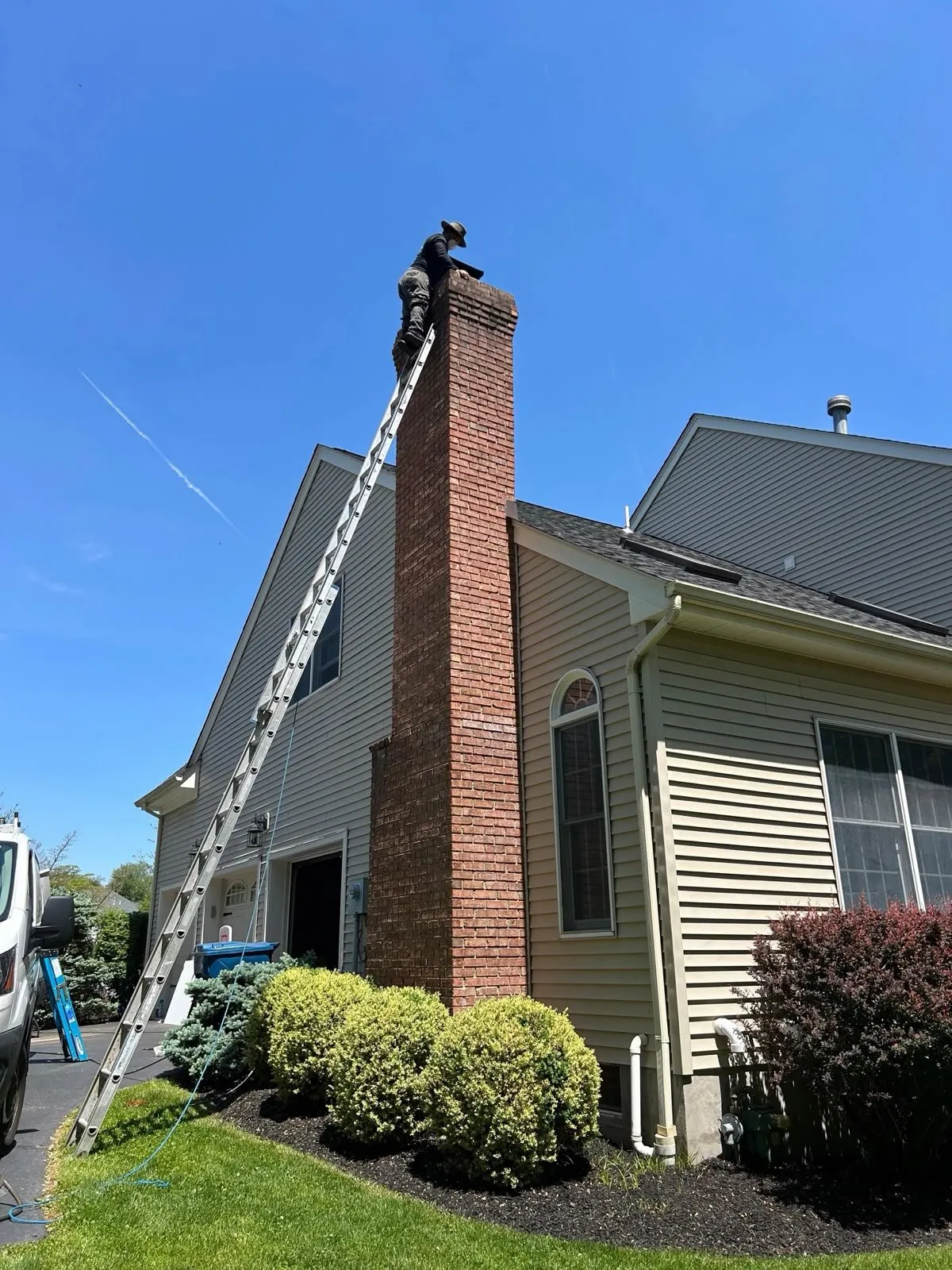
Rebuilding is the last answer on the list, and it should be. Caps, crowns, flashing, liners and mortar joints can each be repaired on their own, and most chimney repair work stays there. A rebuild comes up when the masonry itself has stopped holding together: bricks moving by hand, joints gone several courses deep, a stack leaning off plumb, or a section damaged by a storm, a fallen limb or a house fire.
The age of New Jersey housing makes this a real question in many places. Stacks on the prewar streets of Essex County and Union County have stood through a century of freezing and thawing. Exposed chimneys in Asbury Park and Long Branch take salt wind with nothing to break it. Abandoned coal-era stacks in Hudson County and Paterson have sometimes gone decades without anyone repointing a joint, because nothing connected to them gave anyone a reason to look. This page covers when a rebuild is the right call, how much of a chimney usually comes down, what can be improved during the work, and how permits and a working flue fit in.
When does a chimney need to be rebuilt instead of repaired?
A chimney needs rebuilding when the masonry can no longer hold itself together or stand straight, so repair would only be patching over a structural failure. The clearest signs are a stack that leans, bricks that shift when pressed, wide cracks that run through several courses, and spalled faces across large areas of brick. Mortar that has washed out deep inside the wall, not only at the surface, leaves nothing for repointing to bond with.
The cause matters as much as the symptom. Most rebuilds above the roofline trace back to a crown that failed years ago and let water work down through the brick. A lean can come from sulfate attack, where wet mortar joints swell on one side of the stack, or from a footing that has settled, and those two call for different scopes. A lean at the roofline is one question, and a whole exterior chimney pulling away from the house is another. A chimney that has moved should not be used until someone has looked at it, and if the top looks ready to fall, keep people clear of the area below.
How much of the stack comes down in a rebuild?
Most rebuilds cover only the part above the roofline or the top several courses, because that is the masonry exposed to the worst weather. Taking the stack down to sound brick and laying it back up leaves everything below undisturbed. Where damage is confined to the top, a few courses and a new crown can be enough. A roofline rebuild goes down to the point where the stack passes through the roof, with new flashing as part of the job.
A full rebuild runs from the footing or the first floor up, and it is rare. It comes up for an exterior chimney that has separated from the house, a stack with a failed foundation, or fire damage that reached the lower structure. The flue tile usually comes out with the brick, so a rebuild is often the moment to set new liners. A house with several flues in one stack keeps all of them working only if each one is rebuilt in its original position or deliberately closed.
What can be improved during a chimney rebuild?
A rebuild is the chance to correct what caused the failure, starting at the top with a real crown instead of a thin wash. New Jersey's residential code calls for a sloped cap with a drip edge and a bond break around the flue liners, and the new masonry is the moment to get that right. Height is the next check. The code has a chimney extend at least 3 feet above the highest point where it passes through the roof and at least 2 feet higher than any part of a building within 10 feet, a rule that matters on a house that added a dormer or a second story near an old stack.
On the roof side, the code calls for a cricket where the chimney measures more than 30 inches parallel to the ridgeline and does not meet the ridge, so water and snow are not trapped behind it. Flashing goes in fresh. Brick and mortar are matched as closely as the old stack allows, and on prewar houses the mortar is kept softer than the brick. The old chimney's color has weathered for decades, so a new section may look a little brighter for its first few years.
Is a permit needed to rebuild a chimney in New Jersey?
Ask the town building department before work starts, because the answer depends on the municipality and the scope of the job. Rebuilding a few courses is a different question from replacing a whole chimney, and a new liner may be looked at differently from masonry. A short call settles it, and it is better settled before the bricks come down than after.
Older neighborhoods can add a step. If the house sits in a historic district, as some do in Montclair, Morristown and Princeton, exterior changes to a chimney can call for a local review of the shape, the brick and the crown. A condo or a two-family in Hoboken or Jersey City adds another, since the chimney may belong to the whole building and the decision to the association. The written scope from the evaluation helps in any of these conversations.
What happens to the fireplace and furnace during a rebuild?
Any appliance venting through the stack has to stop until the flue is restored and safe again, so a rebuild is planned around the heating season wherever the weather and the damage allow. Mortar and crown work want temperatures above freezing to cure. A failing chimney may not wait for spring, in which case the top is made safe first and the rebuild is scheduled once conditions allow. Your heating contractor should know the plan if a furnace, boiler or water heater uses that flue.
Every rebuild starts with an evaluation of the full chimney, with photographs from the roof and a part-by-part estimate that costs nothing. If a smaller repair will do the job, you hear that first. AMG is licensed and insured as NJ HIC 13VH13654300, and the veteran owned company picks up 24 hours a day, 7 days a week from its base in Elizabeth, so a stack damaged in a storm can be looked at soon after it happens. Once the masonry is back up, a new chimney cap and a sweep of any flue that stayed in place finish the work.
What is included
- Evaluation of the whole stack before anything comes down
- Failed masonry taken down to sound brick
- Brick and mortar matched to the house as closely as possible
- Flue tile reset or new liner set as the stack rises
- New sloped crown with an overhang and a drip edge
- New flashing where the stack meets the roof
- Chimney height checked against the roof and nearby walls
- Cap fitted and every working flue checked at the end
Questions and answers
How do I know if my chimney can be repaired or must be rebuilt?
It comes down to what is failing. Cracks, joints and a damaged crown can usually be repaired. Loose bricks across several courses, a lean, or mortar gone deep into the wall usually mean a rebuild. The evaluation shows which, with photographs from the roof.
How much does it cost to rebuild a chimney in New Jersey?
The cost depends on how much of the stack comes down, its height and width, the number of flues, the brick and the access. A few courses at the top is a different job from a full rebuild from the roofline. AMG looks first, and the estimate is free.
Is a leaning chimney dangerous?
It should be treated that way until proven otherwise. A leaning stack can drop bricks onto a roof or a walkway, and movement can open the flue inside. Stop using any appliance connected to it, keep people away from the area below, and have it looked at soon.
Can only the top of a chimney be rebuilt?
Yes, and that is the most common rebuild. The top courses take the worst of the weather, so taking the stack down to sound brick and rebuilding from there, with a new crown, often solves the problem without touching anything below the roofline.
Will the rebuilt part match the rest of the chimney?
It should come close. The crew matches the brick and the mortar color to the existing stack as far as materials allow, and new work weathers toward the old over time. On a prewar house, the mortar mix matters as much as the color.
More questions and answers about our work
Chimney Rebuild across New Jersey
We provide chimney rebuild in every New Jersey county. Choose your county or town for local details.
Ready for cleaner air?
Tell us about your home and get a free estimate.