
Chimney Crown and Crack Repair in New Jersey
Chimney crown and crack repair seals a masonry chimney at the places weather gets in: a split crown, cracked brick and mortar joints that have opened up. Caught while the damage is small, the fix stays at the top of the stack. Left through a few New Jersey winters, the same crack can become loose brick and a far larger job.
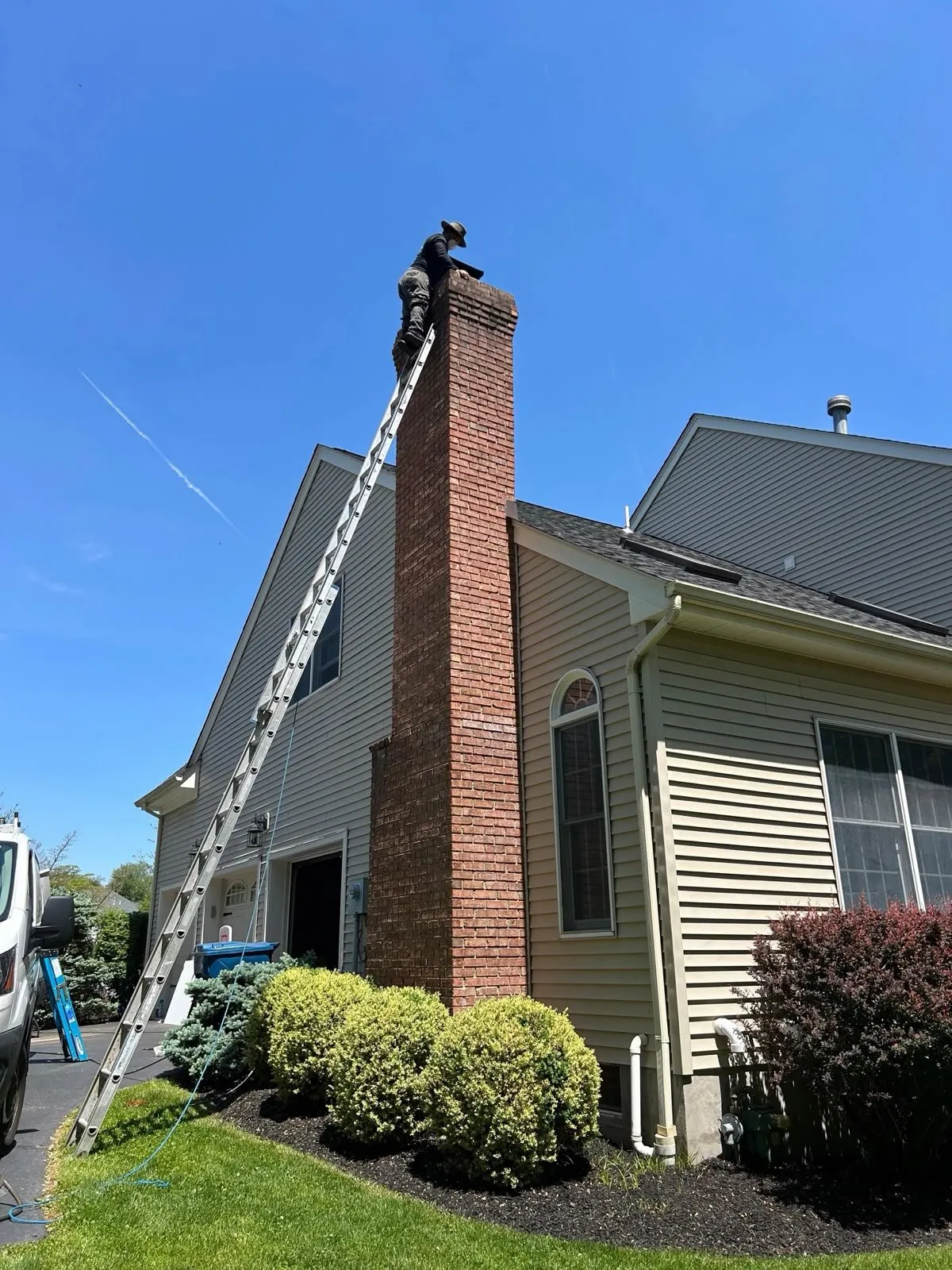
The crown is the slab of concrete or mortar on top of a chimney, around the flue, and it takes more direct weather than anything else on the house. In the prewar neighborhoods of Bergen County and Essex County, many crowns are thin mortar washes troweled on by the original mason. Hudson County chimneys built for coal have often been converted twice, and some were left standing with nothing connected, so nobody looks at the top of them. On the Monmouth County shore, wind off the water drives salt-laden moisture into any opening it finds.
AMG Duct Cleaning seals and rebuilds crowns, repairs cracked brick and repoints failed joints for homeowners across New Jersey, and most of this damage is found during a chimney cleaning, when someone is finally looking at the top of the stack. This page covers why crowns crack, which cracks can be sealed and which cannot, what happens to the masonry below, and how the water travels from a crack to a ceiling. The wider list of chimney repair work, flashing included, has its own page.
What causes a chimney crown to crack?
Most crowns crack because they were built as a thin mortar wash instead of a proper cast slab, then spent decades freezing and thawing. Mortar mixed for laying brick is not made to sit exposed on a flat top, and it shrinks, crazes and takes on water within a few seasons. A crown also has to move. The clay flue tile running up through it heats and cools at a different rate from the concrete around it, so a crown poured tight against the tile tends to split at the corners of the flue.
New Jersey's residential code describes what a sound top looks like, though it says cap where the trade says crown: concrete, metal or stone, sloped to shed water, with a drip edge and a caulked bond break around the flue liners, following ASTM C1283. That standard asks for a slope of at least 10 degrees and an overhang of at least 2 inches past the chimney wall. Older crowns predate those numbers, and many sit flat and flush with the brick, so rain runs down the face of the stack instead of dripping clear of it. Any crown being replaced should be built to them.
Which crown cracks can be sealed and which need a new crown?
Hairline cracks in a solid crown can usually be sealed with a flexible coating made for the purpose, while wide cracks, crumbling edges or a crown that lifts in pieces call for a new one. The test is what lies under the crack. Where the concrete is sound, a coating bridges the gap and keeps water out for a good many seasons. Where the surface flakes or the crack runs through to the brick, a coating is paint over a failed slab, and it lets go with the next hard freeze.
Replacing a crown means taking off the old one and forming a new slab with a slope and an overhang, leaving a flexible joint where it meets the flue tile. On a large house in Montclair, Summit or Princeton with two or three flues in one stack, the crown is wide and the flues sit close together, so the way water leaves the space between them takes more planning. A multi-flue chimney cap often goes on at the same time and keeps rain off the new work.
Why do mortar joints and bricks crack around the chimney?
Mortar joints fail first near the top of the stack, where the masonry is exposed on all four sides and stays wet the longest. Water soaks into the joint, freezes, expands and pushes the mortar out a little further each cycle, and once a joint is open the brick on either side takes on water too. The face of a saturated brick can pop off in a freeze, which the trade calls spalling. Repointing cuts out the failed mortar and packs fresh mortar into the joint, and spalled bricks are replaced before water gets deeper.
Old brick changes the recipe. The National Park Service advises that repointing mortar on historic masonry be softer than the brick around it, because a hard, high-portland mix does not give, and the stress moves into the brick instead. That matters on the stacks around the Morristown Green and on the Victorian streets of Red Bank and Asbury Park, where a stronger mortar can do more harm than the crack it fixed. A stair-step crack down the side of a stack, or a gap opening between an outside chimney and the wall, is a different matter. That shape points to movement, and repointing alone will not settle it.
How does water from a crack reach the inside of the house?
Water from a cracked crown rarely shows up under the crack, which is why the roof usually takes the blame. It soaks down through the masonry, runs along the outside of the flue tile and comes out wherever it meets a ledge or a cooler surface: the smoke shelf, the damper, the plaster beside the fireplace, or a ceiling next to the chase. An unused stack can do this for years, because a flue with no fire in it never dries out and nobody has a reason to look at it.
From the ground, watch for white staining on the brick, called efflorescence, dark patches that stay wet after the rest of the stack has dried, and flakes of brick on the roof or in the gutter. From inside, watch for rust on the damper, a damp smell from the firebox and a stain that grows after wind-driven rain. Where that water has reached ductwork running in a chase beside the chimney, air duct repair or mold treatment and removal can follow the masonry work.
How is a crown and crack repair scoped?
The repair starts with an evaluation from the cap to the firebox, because a crack at the top is seldom the only opening. The crew photographs what it sees from the roof, explains which parts are sound and which are failing, and prices each repair on its own, so a new crown is never bundled with work the chimney does not call for. Crown and mortar work want weather above freezing to cure, which puts most of it between spring and late fall, and a coating or a temporary seal can hold a winter crack until then.
The estimate is free. AMG, licensed and insured under NJ HIC 13VH13654300 and veteran owned, works from a base in Elizabeth and picks up 24 hours a day, 7 days a week, so a piece of crown that fell on the driveway can be looked at before the next storm. If the evaluation finds tile damage as well, chimney flue repair joins the list, and if the top of the stack has begun to lean, the conversation moves to a chimney rebuild.
What is included
- Evaluation of the crown, brick and joints, plus the rest of the system
- Roof photographs of every crack that was found
- Hairline crown cracks sealed with a flexible coating
- New sloped crown with an overhang where the old one has failed
- Flexible joint left between the crown and the flue tile
- Failed mortar joints cut out and repointed
- Spalled or split bricks replaced
- Mortar chosen to suit old brick on prewar stacks
Questions and answers
Should a cracked chimney crown be sealed or replaced?
It depends on the concrete under the crack. Hairline cracks in a sound crown can be sealed with a flexible coating. A crown that flakes, crumbles at the edges or has cracks running through to the brick is replaced with a sloped slab that overhangs the stack.
How long can a cracked crown wait?
Not past the next winter, if you can help it. Every freeze widens the crack and pushes water further into the brick below. A crack found in the fall is worth sealing before the cold arrives, even if the full repair has to wait for warmer weather.
Are stair-step cracks in a chimney serious?
They deserve a close look. A crack that climbs the joints in steps can mean the stack is settling or pulling away from the house, not that the mortar is tired. The evaluation checks whether the chimney has moved, and whether repair or a partial rebuild is the safe answer.
How much does chimney crown repair cost in New Jersey?
The price depends on how much of the crown has failed, the size of the stack, how many flues pass through it and how the roof is reached. Sealing hairline cracks is a smaller job than forming a new crown. AMG looks at the chimney first and gives the estimate free.
Will repointing make the chimney look patched?
It should not, when the mortar is matched to the old joints in color and texture. New mortar looks lighter at first and weathers toward the rest of the stack. On a prewar chimney the mix also has to be softer than the brick, so the match is about more than appearance.
More questions and answers about our work
Chimney Crown and Crack Repair across New Jersey
We provide chimney crown and crack repair in every New Jersey county. Choose your county or town for local details.
Ready for cleaner air?
Tell us about your home and get a free estimate.