A chimney does its real work outside where nobody looks, standing through decades of rain, snow, and repeated freezing before anyone climbs a ladder to check it. In New Jersey, where winters swing through freeze and thaw more than once a season, that repeated cycle is the main force behind damage that eventually shows up as a stain on a ceiling or a chunk of brick in the yard. By the time an owner notices something is wrong, the damage has usually been building across more than one winter.
How freeze and thaw wears down a chimney
Brick and mortar absorb water, and water expands when it freezes, so any moisture sitting in a pore or a hairline crack pushes outward every time the temperature drops below freezing. In a single winter that pressure barely registers. Across many winters of freezing and thawing, it opens mortar joints, flakes the face off brick, and cracks the concrete crown at the top of the flue. A New Jersey winter delivers plenty of that cycling, so a chimney with even a small opening for water tends to age faster than one kept dry and sealed at the top.
Signs that show up on the outside
Spalling brick is the most visible sign, and it looks like the word suggests: the face of the brick flaking, popping, or peeling away in chunks, often leaving broken pieces at the base of the chimney. Spalling usually starts small, a corner here and there, and spreads once water has a wider path into the brick behind the face that already failed.
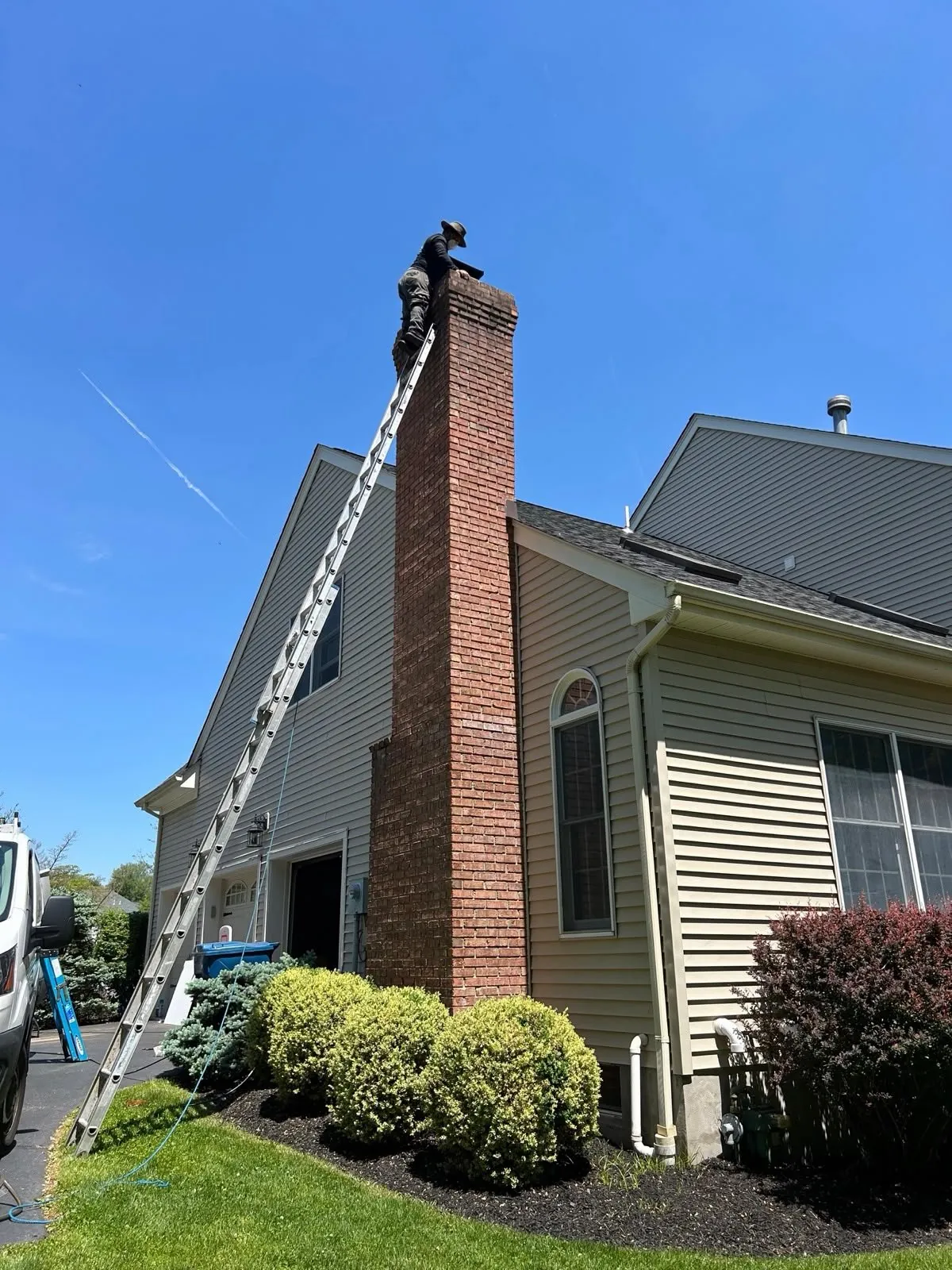
A cracked crown is easy to miss because it sits at the top of the chimney where nobody looks without a ladder. The crown is the concrete or mortar cap that sheds water away from the flue, and once it cracks, water tracks down through it into the chimney structure instead of running off the sides the way it should. A hairline crack rarely causes a problem in its first winter. Left alone, it widens with each freeze.
Missing or crumbling mortar joints show up as gaps between bricks, sometimes deep enough to see daylight through on a chimney that runs along an exterior wall. Running a finger along a joint and having mortar come away as dust or grit is a sign the joint has failed structurally, not only on the surface.
White efflorescence, the chalky staining that appears on brick, is a mineral deposit left behind as water moves through masonry and evaporates at the surface. It does not damage the chimney by itself, but it marks a spot where moisture is moving through the structure, and it is worth tracing back to find the opening.
Signs that show up inside the house
Rust on the damper is one of the clearest inside signs, since the damper is metal and water is the only thing that rusts it. A damper that used to open and close smoothly and now sticks, flakes, or feels rough has usually had water reaching it for a while, often from a crown or flashing failure above.
Water stains on the ceiling near where the chimney passes through the house, sometimes called the chase, point to flashing or crown damage rather than anything inside the firebox. That water travels down the outside of the flue and finds a gap where the chimney meets the roofline, and it often shows up in a bedroom or attic ceiling far from where anyone would think to check a chimney.
Tile pieces in the firebox call for the most attention. The flue is usually lined with clay tiles that keep heat and combustion byproducts contained as they rise. A piece of that tile landing in the firebox means the liner is failing internally, which is a venting issue as well as a structural one, and it should be looked at before the fireplace is used again.
What decides repair versus a full rebuild
Most of the signs above call for repair, not replacement. A cracked crown gets resurfaced or replaced on its own without touching the rest of the structure. Failed mortar joints get repointed, where the old crumbling mortar is removed and new mortar packed into the joint to match the surrounding brick. Rust on a damper often means replacing the damper and addressing whatever let water reach it in the first place.
A full rebuild becomes the conversation when spalling has gone deep enough that multiple courses of brick have lost structural integrity, when the chimney has visibly separated or leaned away from the house, or when the flue liner has cracked and shed enough tile that lining the whole run makes more sense than patching pieces one at a time. The difference usually comes down to how far the damage has spread, not which single sign appeared first.
Older homes across New Jersey carry more of this risk
Chimneys built decades ago in towns across Union County and Essex County were built to the standards and materials of their time, and many have gone years between inspections. Age alone does not mean a chimney needs work, but an older chimney that has never had its crown or flashing checked carries a higher chance of hidden moisture damage than one that has been looked at on a regular schedule. The national standard for chimney and vent safety calls for inspecting a chimney at least once a year, which is often enough to catch a cracked crown or an opening joint before a full winter works on it.
What a chimney repair visit covers
A repair visit starts with a full look at the chimney, from the base in the basement or crawlspace up through the attic where it runs through one, and up to the crown and flashing at the roofline. Photos and a plain explanation of what is found, and what it means, come before any work starts, so the choice between a small repair and a larger project is made with the full picture rather than a guess from the ground.
Once repairs are done, a Chimney Cleaning clears out debris that came loose during the work, along with buildup that was already there, so the flue starts the season in the condition the repair was meant to restore. Chimney Repair and cleaning are billed separately because they address separate problems, but scheduling them together on an older chimney saves a second visit and gives one technician the full picture before the season's first fire.
None of these signs demand a full rebuild on their own, but each one is worth checking before the first cold snap rather than after the season's first fire reveals a smell, a stain, or a sound that was easy to ignore back in October.