Chimney Cap Installation in New Jersey
Chimney cap installation puts a covered, screened top on a flue or a whole stack to keep out rain, animals and debris. AMG Duct Cleaning fits new caps and replaces rusted or blown-off ones across New Jersey, sized to the flue and chosen for the weather the house sees, from salt wind in Monmouth County to the leaf fall and ice of the Morris County hills.
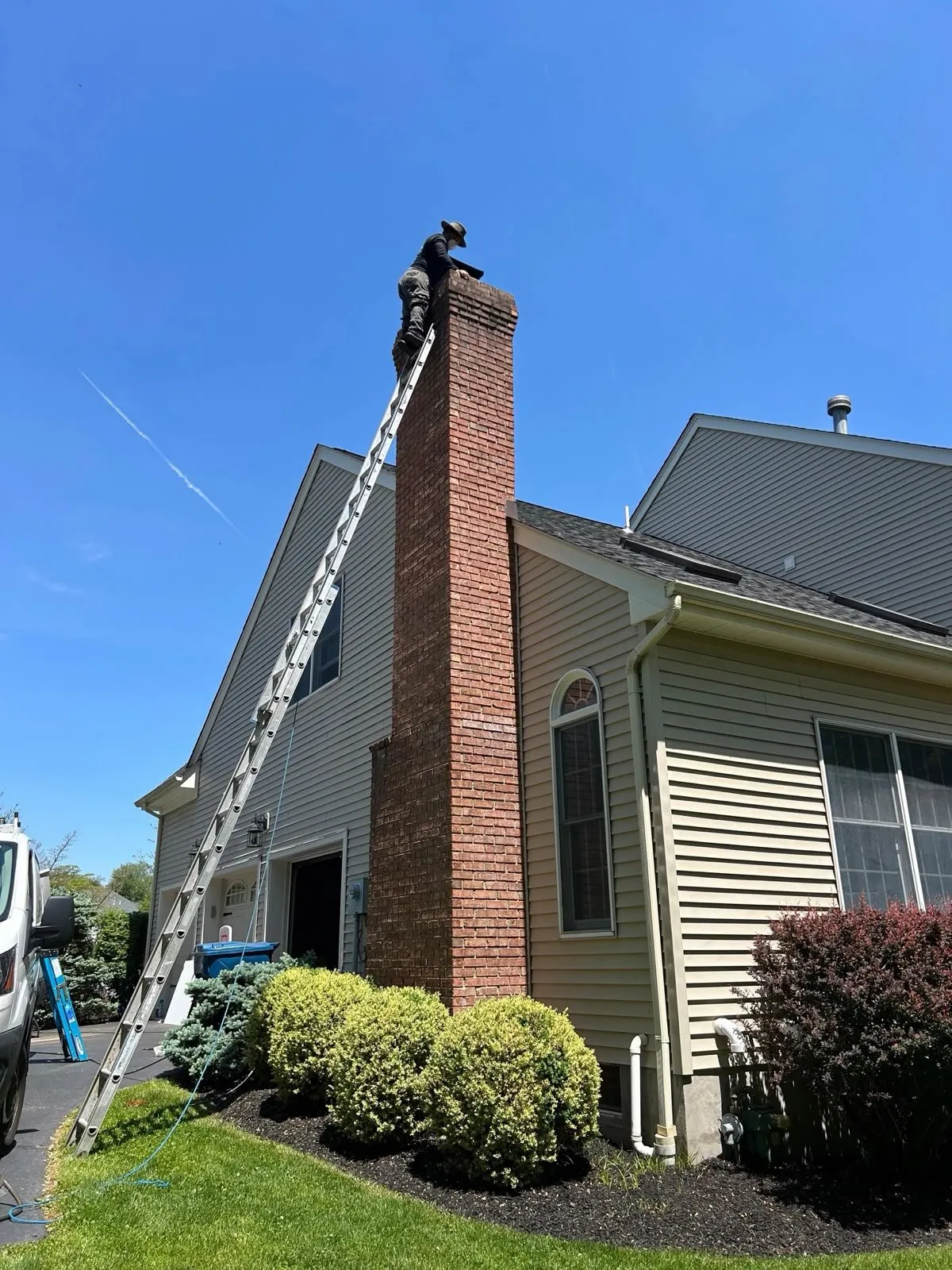
An open flue is a hole in the roof with a warm, dry shaft under it. Rain falls straight down onto the smoke shelf and the damper, a squirrel or a bird finds a nesting spot, and leaves collect on top of whatever is already there. A chimney cap is usually the smallest job on the chimney repair list and the one that does the most to protect everything below it, which is why it is one of the first things checked on any evaluation.
New Jersey chimneys lose their caps in different ways. On the shore in Long Branch, Asbury Park and Middletown, salt air eats through thin metal faster than anywhere inland. Under the old trees of Summit, Ridgewood and Princeton, a screen clogs with seed pods and soot. The large Victorians of Essex County often carry two or three flues in one stack, some abandoned when the heat changed over, and those idle flues usually have the worst caps of all, or none. This page covers what a cap does, which materials last where, how a cap is sized, and when an old one has to go.
Does every chimney need a cap?
Every open flue is better off with one, even though New Jersey's residential code does not require a rain cap on each chimney. The code sets the terms for a cap once it is installed. The value is practical: a cap stops rain from running down the flue, keeps wildlife out and holds back the leaves that would otherwise choke the draft of a boiler or water heater on the same stack.
That goes for flues nobody uses. A stack with one working boiler flue and one dead fireplace flue takes on rain through both, and the idle one has no heat to dry it. Water that gets in there soaks the masonry shared with the working flue. Covering the whole stack, or capping each flue on its own, keeps the unused side from damaging the side the house depends on. A brick or stone chimney built with a good crown still wants a cap, since the crown protects the masonry and only the cap protects the opening.
Which chimney cap material holds up best in New Jersey?
Stainless steel is the usual choice for most New Jersey houses, and copper is the other long-lasting option, while thin galvanized caps rust out soonest. A galvanized cap can look fine for a few years, then the mesh goes at the corners and the lid starts to shed flakes onto the crown. Black painted steel behaves the same way once the paint fails.
Salt changes the math. Within reach of the ocean and the bayshore, ordinary metal corrodes sooner than the same cap would in Bergen County, and the fasteners often go before the lid does, so a cap that looks whole can lift off in a nor'easter. On those houses the metal and the fasteners both get chosen with the salt in mind. On an oil-fired flue, the acidic residue in the exhaust is hard on thin metal too, and a screen sits in the flue gas every time the burner runs. What decides the life of a cap is how it is fastened and what it is made of.
How is a chimney cap sized for one flue or a whole stack?
A single-flue cap is sized to the outside of the flue tile, and a multi-flue cap is sized to the top of the stack so one lid covers every flue at once. Single caps clamp or fasten to the tile that stands above the crown. Where tiles sit at different heights, or a chimney has no tile showing at all, a multi-flue cap usually fits better, fastened to the crown or the brick.
The cap cannot choke the flue. New Jersey's residential code says the net free area under a rain cap, and through a spark arrestor screen, has to be at least four times the net free area of the flue outlet. A screen's openings cannot be larger than 1/2 inch, and the cap or screen has to be removable so the flue can be cleaned. That is why a cap is measured to the flue it serves and not picked by eye, and why a tight lid set low over a large flue can cause the same smoke problem it was bought to prevent.
When does an old cap have to be replaced?
An old cap has to go once the metal is rusted through, the mesh has torn or the fasteners no longer hold, because none of those failures can be patched for long. A cap that rattles in wind, sits crooked or leaves rust streaks down the crown is on its way out. Torn mesh is an open door for birds and squirrels, and a nest in a flue that shares a stack with a furnace can block the draft.
A screen packed with soot or creosote is a different case. The sweep can often brush it clean, but on a heavily used wood flue the mesh clogs again, and a fire that used to draw starts to smoke. If that keeps happening, a cap with a larger open area may suit the flue better. Where the fire has a real share of the heating, as with the stoves in Howell and Hopewell, the screen gets checked every time the flue is swept.
What will a new cap not fix?
A cap keeps water out of the flue, not out of a cracked crown or lifted flashing, so a leak that continues after a new cap was fitted is coming from somewhere else. The evaluation looks at the crown and the flashing before the cap goes on, and if the crown is split, chimney crown repair belongs on the same scope. A cap also will not cure a flue that drafts badly because it is too short, too large or blocked lower down.
A factory-built fireplace is its own case: the metal chimney was tested with a matching top, so the replacement has to match the label on the unit. Every cap job begins with a free estimate. AMG is veteran owned, licensed and insured as NJ HIC 13VH13654300, and the line stays open 24 hours a day, 7 days a week, so a cap lost in a storm can go on the schedule before the next rain. When the flue has not been swept lately, chimney cleaning usually comes first, so the new cap closes over a clear flue.
What is included
- Flue tile and stack measured before any cap is chosen
- Single-flue caps for one working flue
- Multi-flue caps that cover every flue in the stack
- Metal suited to salt air or inland weather
- Removable cap or screen so the flue can still be swept
- Rusted or blown-off caps taken away and replaced
- Crown and flashing checked before the cap goes on
- Matching tops for factory-built chimneys
Questions and answers
How much does chimney cap installation cost in New Jersey?
It depends on the size and number of flues, the metal, and how the roof is reached. A single-flue cap on an easy roof is a smaller job than a custom-sized lid over a wide stack with three flues. AMG measures the chimney first, and the estimate is free.
Can a chimney cap stop a downdraft?
Sometimes. A cap blocks rain and can reduce the wind blowing across an open flue, which helps on an exposed stack. A downdraft caused by a short chimney, a nearby taller roof or a house under negative pressure calls for a closer look at the flue and the house.
Do I need a cap on a chimney I never use?
Yes, unless the flue is sealed some other way. An idle flue takes on rain and animals like any other, and its water soaks the same masonry as the working flues around it. A multi-flue cap covers both for one job.
What is the difference between a chimney cap and a crown?
The crown is the masonry or concrete top that sheds water off the stack. The cap is the metal lid and screen over the flue opening. The code uses the word cap for the masonry top as well, which is why the two names get mixed up.
There is a nest in the flue. Can the cap go on anyway?
The flue has to be clear first. A nest under a new cap stays a fire hazard and a blockage. The sweep removes what it can reach, and the cap goes on afterward. If an animal is still living in the flue, it has to be out before the top is closed.
More questions and answers about our work
Chimney Cap Installation across New Jersey
We provide chimney cap installation in every New Jersey county. Choose your county or town for local details.
Ready for cleaner air?
Tell us about your home and get a free estimate.