Chimney Damper Repair in New Jersey
Chimney damper repair frees or replaces the metal plate that seals a fireplace flue between fires and swings out of the way when one is lit. AMG Duct Cleaning fixes stuck, rusted and warped dampers across New Jersey, and where the original throat damper is past saving, a top-sealing damper can take over the job from the top of the chimney.
A damper does its work quietly until the day it will not move. Then the handle will not budge, the plate has dropped out of its frame, or cold air pours down the flue all winter because the plate has rusted partly open. In a New Jersey house, that usually means water has been coming down the chimney for a while, since rust is what seizes most dampers. A stuck damper is also worth more attention than it gets, because a fire lit under a closed or half-open plate puts smoke and carbon monoxide straight into the room.
Older fireplaces in Essex County, Union County and Bergen County still run the cast iron throat dampers they were built with, some of them a century old and operated by a poker or a ratchet handle. The fireplaces added to postwar capes and colonials usually have a lighter plate on a rotary handle, and those rust out too. This page covers what a damper does, why it sticks, when it can be saved, how a top-sealing damper works, and what happens to the damper when gas logs go in.
What does a chimney damper do?
A damper is a movable metal plate that lets smoke out during a fire and, once the fire is dead, keeps heated air in and cold air out. Most sit in the throat of the fireplace, a few feet above the hearth, and New Jersey's residential code calls for a ferrous metal damper on a masonry fireplace, at least 8 inches above the top of the opening and operable from the room containing the fireplace.
An open flue on a winter night behaves like an open window at the top of the house. Warm air rises out of the living space, cold air replaces it, and the furnace works harder. The opposite failure is the dangerous one. A damper that will not open fully, or that falls shut during a fire, stops smoke from leaving. Always check that the plate is open before lighting anything, and leave it open until the embers are fully out, since coals keep giving off carbon monoxide after the flames die.
Why does a chimney damper get stuck?
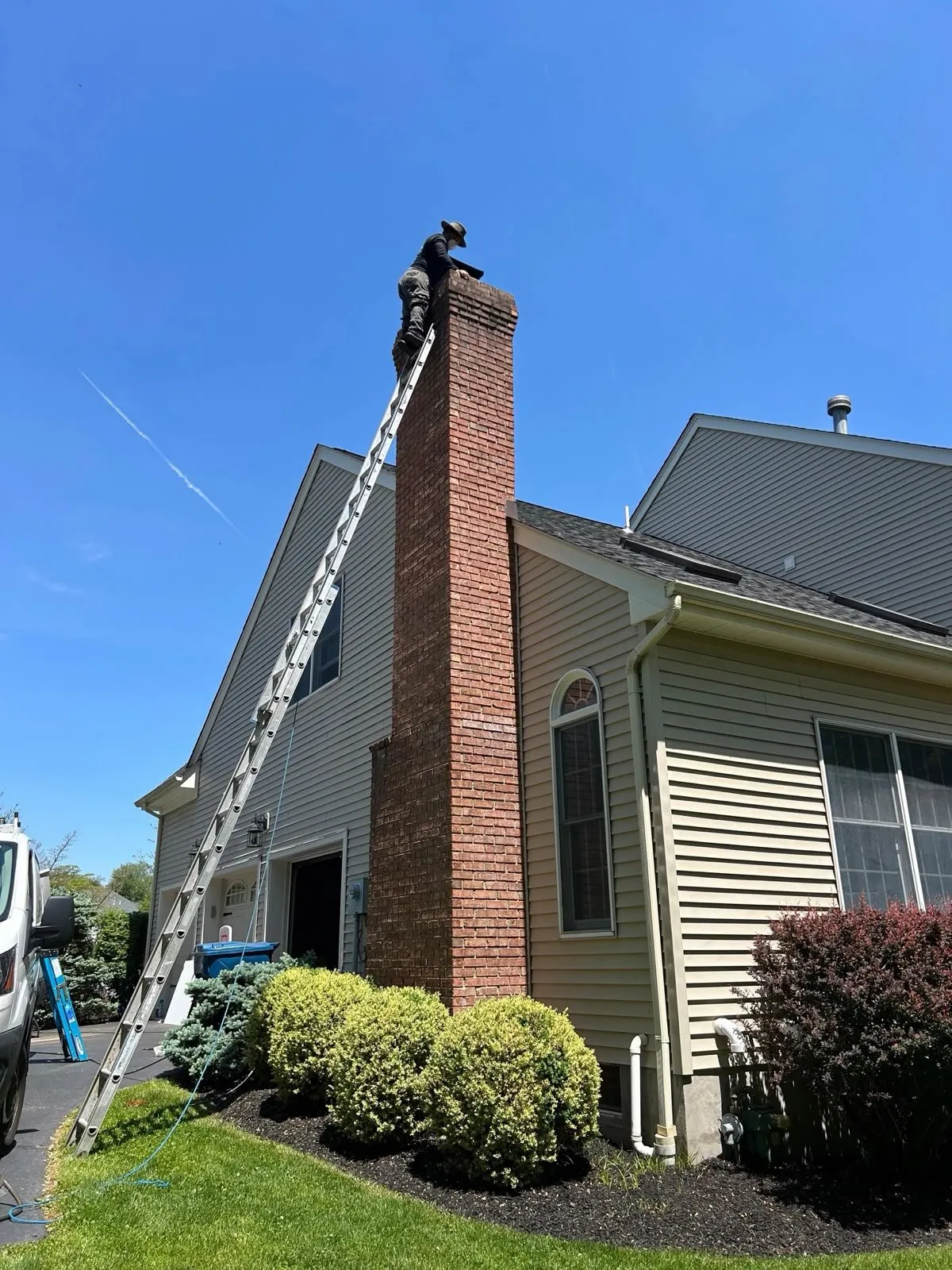
Most dampers stick because rust has built up on the plate, the pivot or the frame, and that rust comes from water getting into the flue. A missing cap lets rain land right on it. A leaking crown lets water run down the inside of the masonry to the same spot. Every wet season adds a layer until the plate seizes, which is why a stuck damper is often the first sign of trouble at the top of the stack.
Heat and buildup cause the rest. A large fire can warp a thin plate so it no longer sits flat in its frame, creosote can glue the edges in place on a heavily used fireplace, and bits of fallen mortar or a nest can jam the plate from above. Handles and linkages wear out as well, so the plate itself may be sound while the rod that moves it has snapped. On the shore, salt air speeds all of it up, and a damper in a fireplace near the water can seize long before one in Morris County.
Can a stuck damper be repaired, or should it be replaced?
A damper can usually be repaired when the plate and frame are solid and only the movement has failed. A sweep clears the creosote and debris around it, the pivots are freed, and a broken handle or linkage is replaced. If the plate still closes reasonably flat against the frame afterward, the fireplace is back in order.
Where the plate has rusted through, warped badly or fallen out of a frame that is itself coming apart, repair stops making sense. Replacing an old throat damper means working inside the firebox and the smoke chamber, and on older fireplaces the frame may be built into the masonry, which limits the options. That is where a top-sealing damper earns its place. The chamber overhead gets checked at the same time, because smoke chamber repair and damper work share the same few feet of chimney and are easiest done together.
What is a top-sealing damper, and when does it make sense?
A top-sealing damper is a spring-loaded metal lid mounted at the top of the flue, with a cable running down to a handle in the firebox. When it is closed, the seal sits above the whole flue rather than at the throat, so warm room air does not fill the chimney and cold air does not sink through it. The code allows a damper to be installed in the fireplace or in the chimney venting the fireplace, as long as it can be operated from the room.
It suits a fireplace with a seized or missing throat damper, a large old opening with a poor seal, or a house where cold air and summer soot smell keep coming through the firebox. Most models also double as a rain and animal cover on that flue, although a multi-flue stack may still call for a full chimney cap. It does not suit every chimney. The cable has to reach the firebox, the top of the tile has to be sound enough to hold it, and on the shore the hardware has to stand up to salt. It is a fireplace part and does not go on a flue serving a furnace, boiler or water heater.
What happens to the damper when gas logs are installed?
Vented gas logs are installed with the damper held open, so the old plate cannot go on being closed between fires. The maker's instructions set a permanent opening or a clamp that stops the plate from closing past a certain point, because a pilot or burner under a closed damper sends its exhaust into the room. Before gas logs go into an old fireplace, the flue has to be open, the damper has to be fixed to those instructions, and a seized plate cannot be left in a half-open position by guesswork.
The evaluation covers the damper along with the rest of the chimney, and you get photographs and a free estimate before work starts. AMG, a veteran owned company that is licensed and insured (NJ HIC 13VH13654300), takes calls 24 hours a day, 7 days a week, so a damper that jammed the night of a planned fire can be looked at before anyone lights it. Where rust caused the problem, chimney repair at the cap or crown stops it from coming back.
What is included
- Sweep and clearing of debris around the plate
- Check that the plate opens fully and closes flat
- Pivots freed and rust cleared where the metal is sound
- Broken handles, rods and linkages replaced
- Top-sealing damper fitted where the throat damper has failed
- Cable and handle tested from the firebox
- Damper set to the log maker's instructions on gas log fireplaces
- Top of the stack checked for the water that caused the rust
Questions and answers
Can I use the fireplace if the damper is stuck?
Not if the plate is closed or only partly open. Smoke and carbon monoxide will spill into the room. If it has seized fully open, a fire may draw normally, but the house loses heat up the flue between fires. Have it looked at before relying on it.
How much does chimney damper repair cost in New Jersey?
The price depends on what failed. Freeing a pivot or replacing a handle is a small job, and a new top-sealing damper means work at the top of the chimney as well as the firebox. AMG looks at the plate first and gives the estimate free.
Why does cold air come out of the fireplace when the damper is closed?
The plate is probably not sealing. Throat dampers are metal on metal and rarely airtight, and rust or warping widens the gaps. If the draft is bad enough to feel across the room, a top-sealing damper closes the flue at the top and usually cuts it sharply.
Will a top-sealing damper replace my chimney cap?
On a single-flue chimney, many models cover the opening and also keep rain and animals out, so the old cap may come off. On a stack with several flues, or where a fireplace flue sits next to a furnace flue, a full cap is usually still the better cover.
Why does my fireplace smell in summer with the damper closed?
Humid air wakes up the creosote smell, and a house that pulls air down the flue brings that smell into the room. A sweep removes the deposits, and a damper that seals properly, at the throat or at the top, stops the air from moving.
More questions and answers about our work
Chimney Damper Repair across New Jersey
We provide chimney damper repair in every New Jersey county. Choose your county or town for local details.
Ready for cleaner air?
Tell us about your home and get a free estimate.