
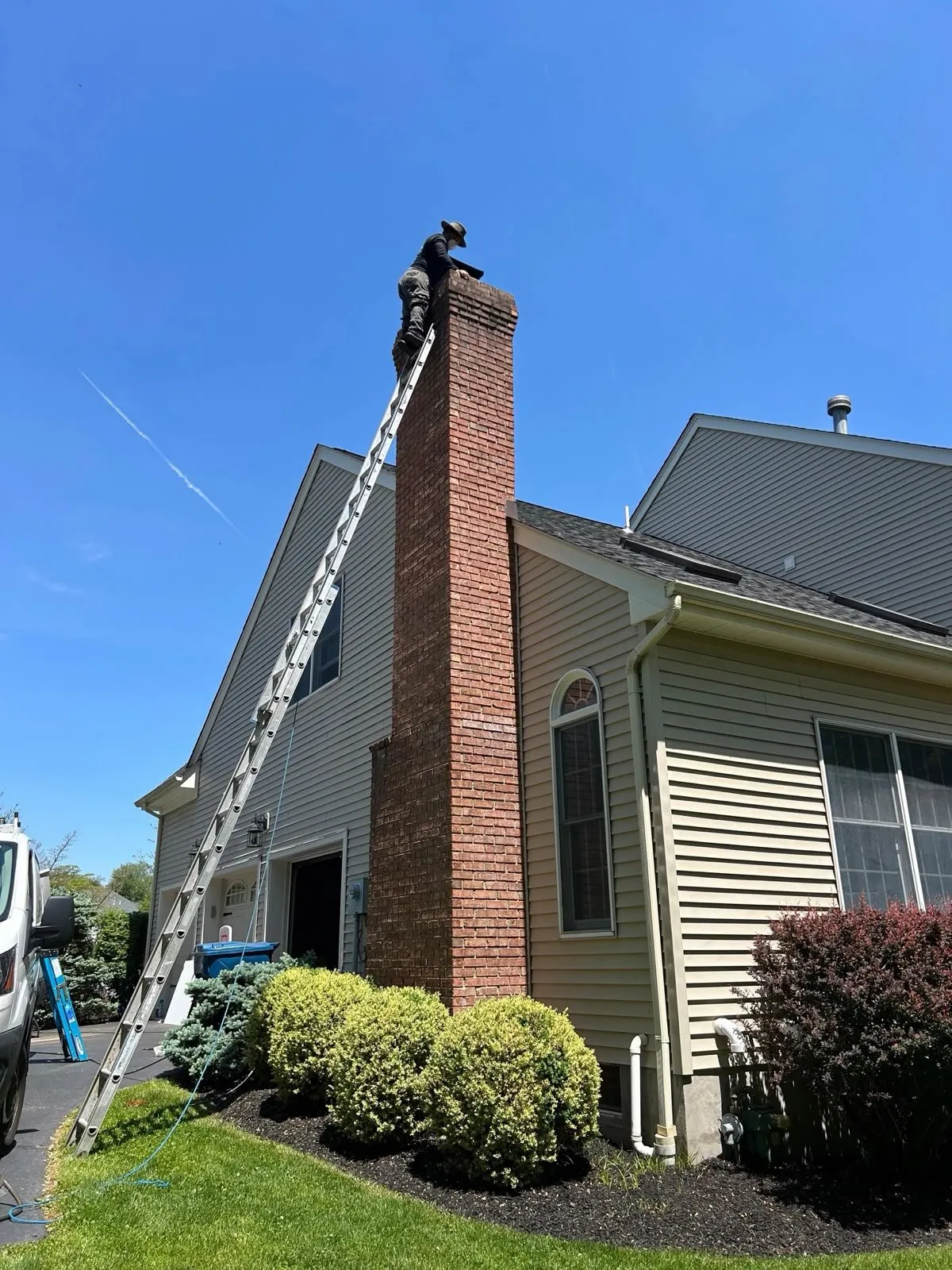
The white staining is efflorescence, a crust of mineral salts pulled to the surface of the brick or mortar as water moves through the masonry and evaporates. The stain itself does not damage anything and does not spread like mold does. What it tells you is that water got into the masonry somewhere, dissolved salts already present in the brick or the mortar, and carried them outward as it dried. The salt crust is a marker. The water that made it is the part worth finding before another winter of freeze and thaw works on the same crack.
Where the salt comes from
Brick and mortar both contain small amounts of soluble salts as part of their makeup. Under normal conditions those salts stay put. Once water gets into the masonry through a crack, a gap, or a porous surface, it dissolves whatever salt it touches and carries it along as it moves toward the drier side, usually the exterior face of the chimney. When the water reaches the surface and evaporates, the salt stays behind as a pale, chalky residue. More water moving through the same path means more staining over time, which is why a stack that keeps producing fresh white patches after every rain has an ongoing entry point rather than a one time event.
Why the stain sits below the crown or on one side
The location of the staining is a clue worth reading before anyone starts scrubbing. A band that sits just below the crown, the mortar cap on top of the stack, usually points to a crack or gap in that crown letting rain soak straight into the masonry underneath it. Staining concentrated on one face of the chimney, especially the side facing the roof slope, points more often toward flashing, the metal strip sealing the joint where the chimney meets the roofline. Staining scattered across several courses of brick, rather than one clear band, can mean the mortar joints themselves have opened up and are letting water in at multiple points along the stack.
Efflorescence versus mold on masonry
Efflorescence is a powdery, pale deposit that often brushes off somewhat dry and returns after the next wet spell. Mold on masonry or on the framing around a chimney chase looks and behaves differently: darker in color, often green, black, or gray, with a fuzzy or slick texture rather than a dry crust, and it tends to hold on in spots that stay damp rather than dry between wet periods. Mold growth needs ongoing moisture to keep going, which is consistent with a chimney leak that has been running for a while without being traced. Treating the two the same, by scrubbing and painting over either one, leaves the underlying moisture problem untouched.
Mold Treatment and Removal at AMG covers the duct system and the HVAC equipment connected to it. Growth found on chimney masonry or on framing around a chase sits outside that scope, since the material and the right remediation approach are different from ductwork. A mason or a remediation contractor who works directly with brick, mortar, and framing is the right call for growth found on those surfaces, while the chimney itself, crown, cap, flashing, and joints, is where the leak gets traced and closed.
Why washing the brick and sealing it misses the point
Pressure washing the stain away or brushing on a masonry sealer changes how the chimney looks for a season, not what is happening inside it. If the crack in the crown or the gap in the flashing stays open, water keeps entering and the salt keeps traveling to the surface, so the staining returns. Sealing the exterior face without closing the entry point can make things worse in a New Jersey winter, because water already inside the masonry has nowhere left to evaporate and instead sits through repeated freeze and thaw cycles, which is one of the faster ways to crack and spall brick that has otherwise held up for decades.
Tracing the leak to its source
A proper look at the stack checks each component that commonly lets water in. The crown, the mortar cap across the top, is inspected for hairline cracks that widen with each freeze. The cap, the metal cover that keeps rain and animals out of the flue opening, is checked for rust, gaps, or a poor fit. Flashing where the chimney meets the roof is checked for lifted edges or failed sealant. Mortar joints along the full height of the stack are checked for erosion or open gaps between bricks. Narrowing the cause to one of these, rather than guessing, is what keeps the repair limited to the part that failed.
Older stacks and unused flues
Older masonry chimneys around towns like Morristown and Montclair in Morris County have often gone through decades of freeze and thaw cycles on the original crown and mortar, and a crown that was sound twenty years ago can carry hairline cracks today that only show up as fresh staining after a wet stretch. In multi-unit buildings across Hudson County, a flue that is capped off or rarely used can take on water for a long stretch without anyone noticing, since there is no fireplace use to prompt a look up the chimney. The staining or a damp patch inside a closet or basement wall is often the first sign that an unused flue has been letting water in the whole time.
When repair follows the trace
Once the entry point is confirmed, Chimney Repair addresses the specific component that failed rather than the whole stack by default. That might mean crown and crack repair, a new cap installation, flashing work tied into the repair, or flue repair and relining if water has been reaching the liner itself. In masonry that has deteriorated past patching, a full chimney rebuild is the plain answer rather than another round of surface fixes. The staining is the signal that starts that process, not the problem to be erased on its own.
If a stack keeps showing white patches after every rain, the next step is a look at the crown, the cap, the flashing, and the joints, in that order, rather than another wash and a coat of sealer that only buys a season before the same stain comes back.