Salt carried on the ocean wind corrodes thin steel and its fasteners far faster than inland air, so the metal and the way a cap is fastened decide how long it lasts on a shore roofline. In Asbury Park, Long Branch, and along the Middletown bayshore, stacks often stand above the roof with nothing to break the wind off the water, and a cap that would hold up for a long stretch forty miles inland can rust through in a fraction of that time.
What salt does to galvanized and painted steel
A standard chimney cap is galvanized steel, a sheet dipped in zinc so the zinc corrodes first and protects the steel underneath. That coating holds up fine through ordinary weather, but salt in the air speeds up the reaction that eats the zinc, and once the coating thins to bare metal in a few spots the steel underneath starts rusting on its own. A painted cap behaves a little differently. The paint is a thin barrier rather than a sacrificial layer, and once it chips at a seam or a drilled hole, salt reaches the metal directly and rust spreads outward from that one point rather than evenly across the surface.
Why the fasteners and the mesh corners go first
The lid is rarely the first part to fail. Screws, rivets, and the spot welds holding the mesh panels together are often a thinner or lower grade of metal than the cap body, and thin metal with more surface area relative to its mass corrodes faster than a solid lid does. Salt works into the threads of a screw long before it has visibly marked the flat steel around it, and a mesh corner that was spot welded rather than folded is exactly the kind of joint that gives out first near the water. By the time a homeowner spots a rust stain on the lid, the fasteners holding the whole assembly to the flue have often been failing quietly for longer than that.
Stainless steel and copper caps compared
Stainless steel does not rely on a coating the way galvanized steel does, so there is no zinc layer for salt to strip away before rust gets a foothold, which is why stainless holds up longer on a stack that catches the wind off the water. Copper ages differently. Rather than rusting, it forms a patina over time, a surface layer that changes color but does not weaken the metal underneath, and that is part of why copper caps stay sound on shore homes long after a galvanized cap in the same spot would need replacing. That difference shows up in the written estimate rather than in day-to-day performance, since the material a cap is made from is one of the larger factors in what chimney repair or a new cap installation costs.
What a failed cap lets into a multi-flue stack
Many older homes near the water, the Victorians and turn-of-the-century houses common across Monmouth County, have a single masonry stack serving more than one flue, with several openings at the top instead of one. A cap that has rusted through on even one of those openings lets rain fall straight onto the smoke shelf and damper, lets wind-blown debris and nesting material build up on a flue that may not even see regular use, and lets moisture reach brick and mortar that was never built to handle standing water. Repeated soaking from a failed cap is a common path to the crown damage, flue deterioration, and smoke chamber problems that chimney repair work is called in to fix later, and a cleaning alone will not address masonry that keeps absorbing water every time it rains.
What to look for from the ground after a nor'easter
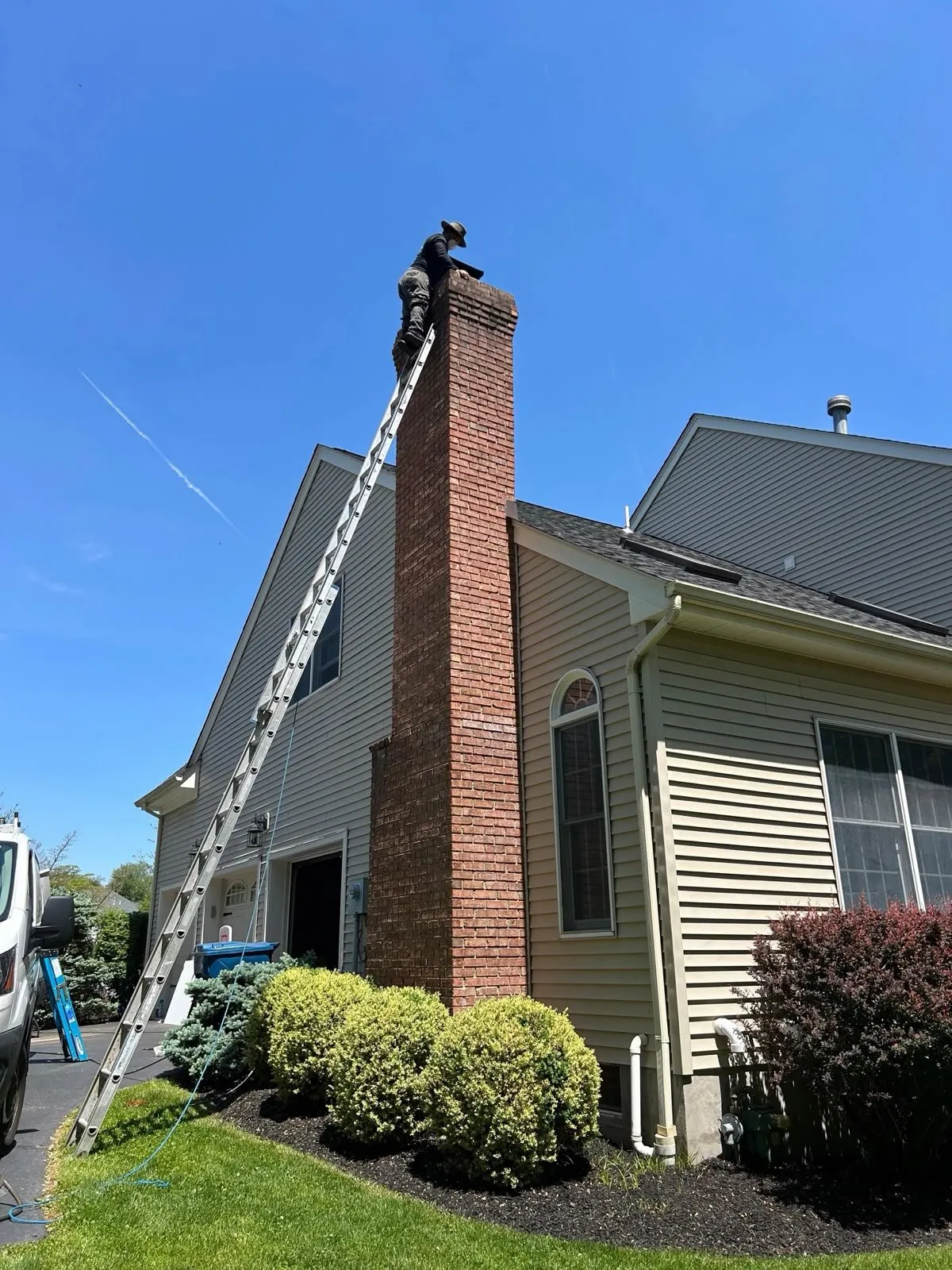
After a storm off the water, it is worth a look from the ground rather than waiting for the next scheduled visit. Rust streaking down the stack below the cap is the most obvious sign, since it means the cap itself is shedding rust onto the brick or siding beneath it. A mesh panel that looks bowed or loose, a lid sitting at a slight angle instead of flat, or a cap that looks like it lost a corner in high wind all call for a closer look before the next rain gets inside. Binoculars from the yard catch most of this. A technician on the roof confirms what is loose, what has rusted through, and what is still sound, which is the kind of detail a chimney cleaning visit covers while the technician is already up there.
What decides the cost of a replacement
Material is the largest factor, since stainless and copper cost more to buy and install than galvanized steel but last longer in a salt environment, and a homeowner weighing that trade-off should ask for both options in writing rather than guessing at the difference. The number of flues on the stack matters too, since a Victorian with three openings at the top needs a cap sized and fastened for each one, not a single lid stretched across all three. Roof pitch and stack height change the access and rigging a job requires, which is also part of the written estimate, along with whether the existing flashing and crown are sound enough to keep a new cap seated the way it should be.