Water showing up in the firebox or running down the inside of the flue after a storm almost always comes in through the crown, the cap, or the flashing, which means the repair happens on the roof and not inside the fireplace. A chimney that has stood through years of rain without a drop inside can start leaking the moment one of those parts fails, and the water that gets past them travels down the flue slowly enough that it often shows up well after the storm has already passed, which is part of why the source gets misread as something inside the firebox itself.
The four ways rain gets into a chimney
Four parts handle the weather on a chimney, and in order of how often each one turns out to be the answer, a cracked or poorly sloped crown, a missing or damaged cap, flashing that has pulled away from the roofline, and mortar joints that have opened up enough to soak through the brick itself. Most leaks trace back to the first two, since the crown and the cap sit directly over the flue and take the brunt of every storm. Flashing and mortar failures tend to surface after the first two have already let water in for a season or more, which is why a chimney that leaked once rarely stops at one cause.
A cracked crown, the most common entry point
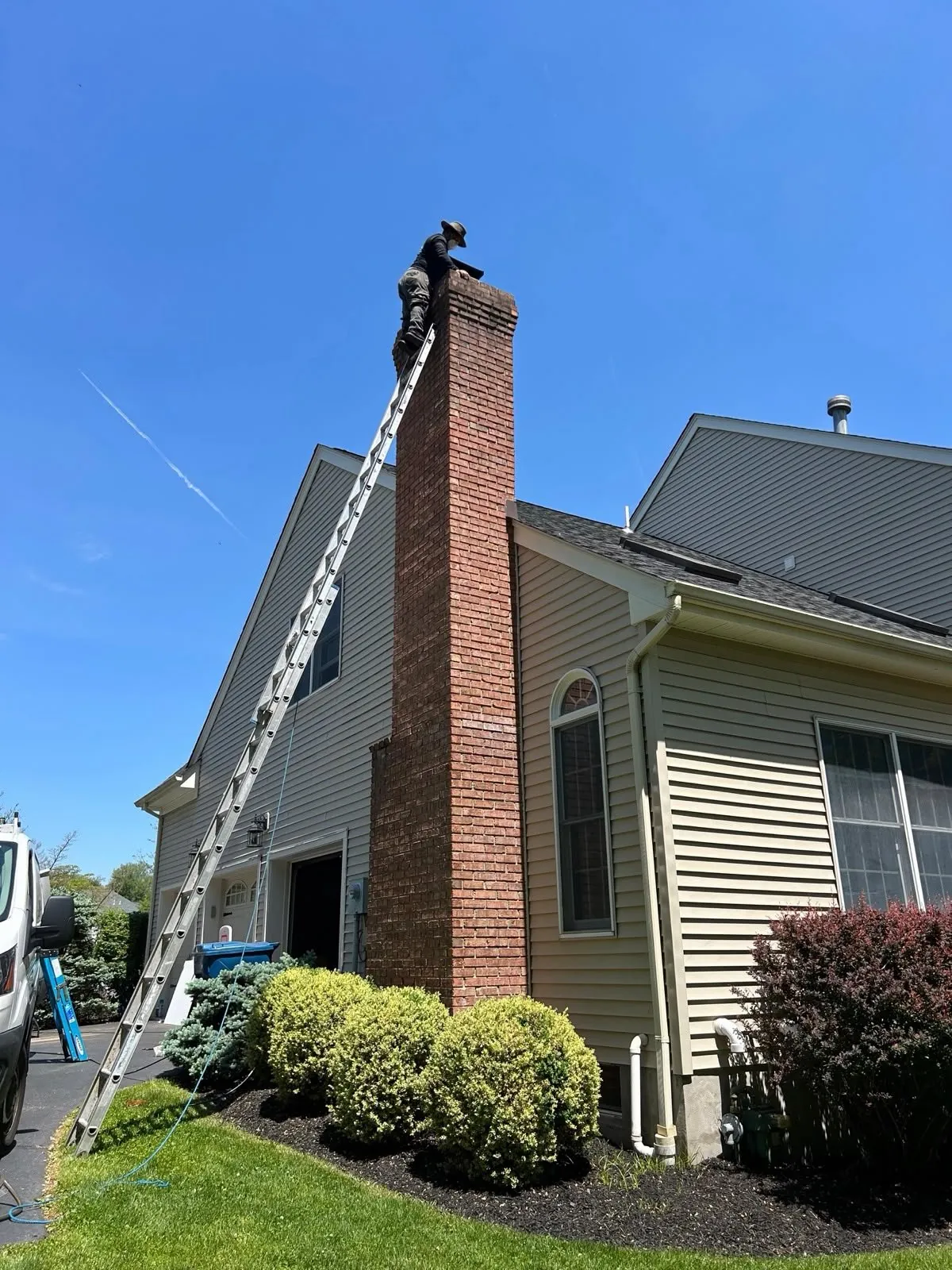
The crown is the concrete or mortar cap poured across the top of the chimney, and it is built with a slope so rain runs off the edges rather than pooling on top. A crown poured flat, or one that has cracked from years of freezing and thawing, holds water instead of shedding it, and that water works down through the crack with every storm. From the ground this often looks like a thin dark line across the top of the chimney, or a crown that looks slightly swayed rather than flat and even. In older masonry chimneys across Bergen County and Passaic County, where a thin mortar wash crown was common instead of a poured concrete one, this failure shows up earlier than it does on chimneys built with a thicker, properly sloped crown.
A missing cap shows up as a stain on the ceiling first
A chimney cap keeps rain from falling straight down the open flue, and a missing or rusted-through cap is often found only after a stain appears on a ceiling near the chimney chase, long before anyone thinks to look at the roof. Without a cap, rain falls directly into the flue on every storm, and wind-driven rain angles in even under a roof overhang that would otherwise offer some shelter. A cap failure tends to put water into the firebox faster and in larger amounts than a cracked crown does, since nothing stands between the open flue and the sky.
What flashing does and how it fails
Flashing is the metal sealed where the chimney meets the roofline, and its job is keeping water from running down the gap between the two different materials. It fails by pulling loose with age, by the sealant along its edge drying out and cracking, or by a roof replacement that reused old flashing instead of resetting it against the new shingles. A flashing leak usually shows up as a stain on the ceiling or in the attic near where the chimney passes through the roof, rather than water in the firebox, since the path it takes follows the roof deck instead of running straight down the flue.
When mortar joints let water through
Mortar joints are the last of the four, and they usually only become the main source after years of a chimney standing exposed to weather with no repointing. Water works into small gaps between the bricks, and in a New Jersey winter that water freezes and expands, widening the gap with each cycle. A chimney with open mortar joints lets water soak through the whole stack rather than tracking down a single path, which is part of why this cause tends to show up as dampness along the chimney chase rather than a clean drip at one spot in the firebox.
What the water does to masonry while it waits
None of this is only about where the water lands on its way in. Masonry absorbs water, and the same freeze and thaw cycle that widens a mortar joint also pushes brick faces apart from the inside, a problem called spalling, where chips and flakes pop off the surface of the brick. A chimney that has taken a season or two of water through a cracked crown or a failed flashing seal often shows spalling by the time anyone looks closely at the exterior. Left long enough, that same cycle can reach the flue liner, and a liner weakened by water is a separate concern from the leak itself, one that affects how safely the chimney can be used at all.
Getting the right part fixed, not the symptom
Because a stain inside the house does not point straight at the part that let the water in, the diagnosis matters as much as the repair that follows it. A technician working through chimney repair checks the crown, the cap, the flashing, and the mortar joints in roughly that order, since that is close to the order of how often each one turns out to be the actual cause, and confirms which one is failing before any work starts. Chimney cleaning is worth scheduling alongside that inspection when the flue has not been checked recently, since standing water and soot residue are easier to evaluate once the flue has been cleared out.
A leak that gets addressed at the right part, the crown resealed and resloped, a new cap fitted, flashing reset against the roofline, usually stops within the next good storm. That is the test worth watching for once the repair is finished, since a leak that returns after rain points to a second cause that the first repair did not reach.