
When we survey a dryer vent installation, we are answering one question: how much has to be opened, crossed or worked around to get a short, rigid, properly terminated run from the machine to the outside?
Everything below feeds that answer. None of it is about the dryer.
Distance to the nearest exterior wall
The dominant factor. A machine sitting against an outside wall is a straightforward afternoon. A machine in the middle of a floor plan needs a path, and the path is where the work is.
Note that distance is not measured in a straight line but in developed length, which counts each elbow as several feet of straight duct. A route that is physically shorter but needs two extra turns can be worse than a longer straight one.
What is between the machine and the outside
This is the part that decides how long the job takes:
- Open basement or unfinished ceiling. Easiest case. The run can be hung and supported without opening anything.
- Finished ceilings and walls. Access has to be made, and made good afterwards. That is a different scope and it should be quoted as one.
- Joist bays that run the wrong way. Crossing joists rather than running with them means either a longer path or boring, which is structural and is not something to improvise.
- Fire-rated or party walls in multi-unit buildings. Any penetration has to maintain the rating, which is a specific detail rather than a hole.
The wall itself
Brick and block take longer to core than vinyl siding over sheathing, and they need a clean, sealed penetration so nothing gets behind the wall.
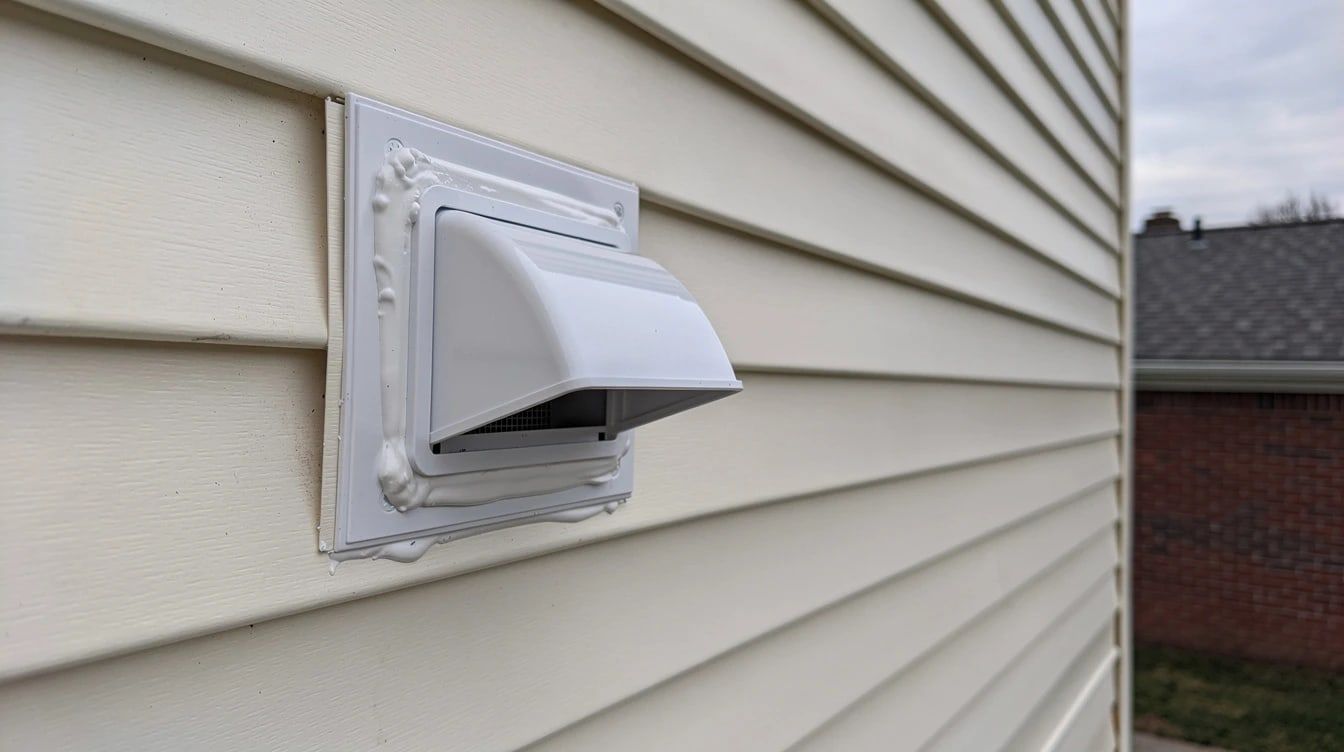
Older masonry in Elizabeth, Paterson or Jersey City can be soft in ways that need care. Stucco has its own detailing. Vinyl siding needs a proper mounting block so the hood sits flat and the flap can swing.
Termination type
A wall hood at reachable height is the standard. Beyond that:
- A high wall termination needs ladder access, both to install and to service later.
- A roof termination needs a rated cap, correct flashing and a plan for how it will be checked in future.
- A shore-area installation needs hardware that will survive salt air. Hoods rust out noticeably faster in Monmouth County than inland.
Whether the existing run can be reused
Sometimes a house already has a compliant path and the problem is only the last few feet or the hood. We will say so. Replacing an entire run that is sound rigid metal with a good route is not work anybody needs.
Conversely, if the existing run is foil accordion duct, has been crushed, or terminates somewhere it should not, reusing it defeats the point of the job.
Whether it is occupied and how much protection is needed
Working in a lived-in laundry room with finished flooring is slower than working in a new build with bare subfloor, because the protection goes down first and the clean-up is real. That time is part of the job rather than an extra.
What we need from you when you call
To give you a useful answer on the phone rather than a guess:
- where the machine will sit, and on which floor
- roughly how far the nearest exterior wall is
- whether the ceiling or wall between the two is finished
- gas or electric
- house, condo or apartment, and whether a building manager is involved
- what is there now, if anything
That is usually enough to say whether it is a simple job, a job that needs a survey, or a job that needs the building involved before anything is scheduled.
The part worth paying for
The short version of all of the above: the route is the product. Duct material and workmanship matter, but a badly chosen path cannot be rescued by good technique, and a well-chosen one is forgiving.
That is why we survey before quoting and why the number does not move once agreed. Details of what the install includes are on the service page, and the code requirements it has to meet are here.


