
Almost everything that goes wrong with a dryer vent over its lifetime was decided on the day the route was chosen. The duct material matters, the workmanship matters, but the path is what determines whether the machine spends the next fifteen years working comfortably or fighting.
Here is how the decision actually gets made.
The principle: spend your elbows carefully
A dryer has a limited amount of push. Codes and manufacturers both express this as a maximum developed length, and every ninety-degree turn counts as the equivalent of several feet of straight duct.
That gives you a budget. A short run with two turns leaves plenty of margin. A long run with five turns has none, and the symptoms of exceeding it are not dramatic: clothes take longer, the machine runs hotter, lint settles instead of leaving, and the household adapts without ever reporting a fault.
So the rule is simple and it drives everything below: the best route is the shortest one with the fewest turns, even when it is not the most convenient one.
Ground floor, exterior wall
The easy case, and the one to aim for wherever the laundry can be placed near an outside wall. A straight shot through the wall with a single elbow behind the machine, a proper hood with a damper, done.
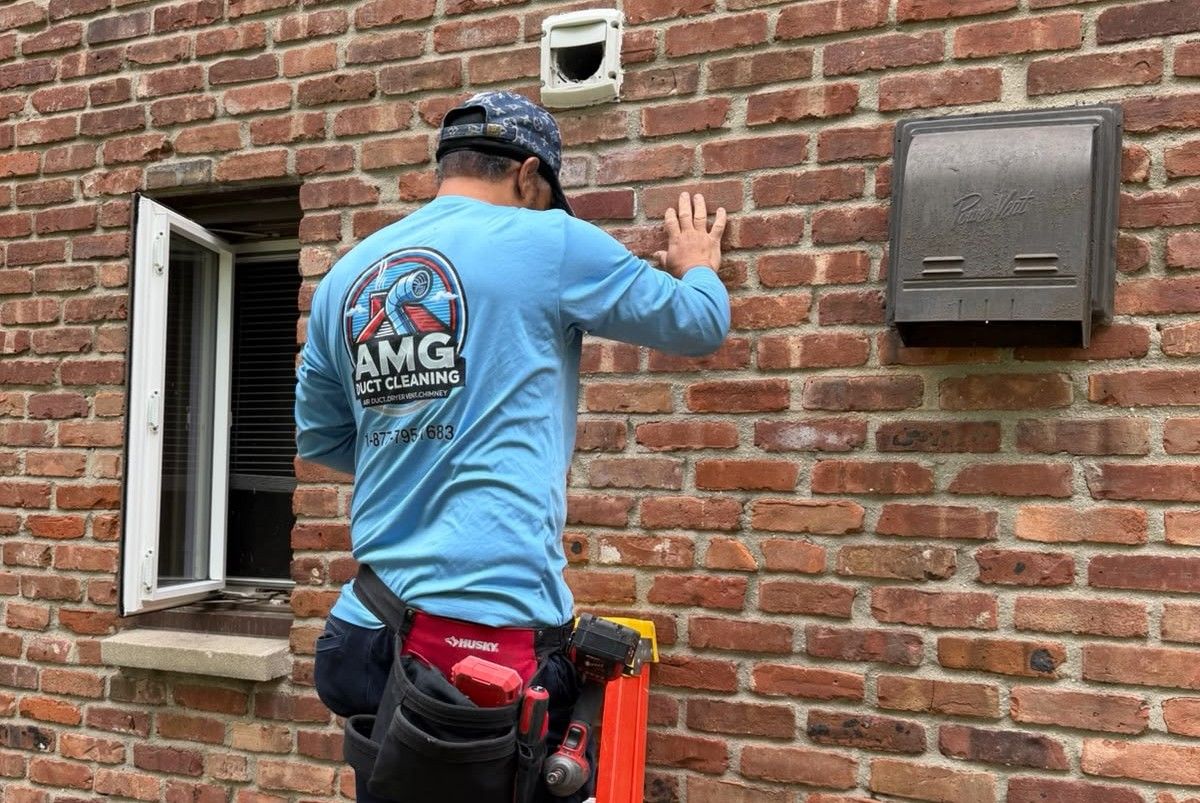
Things to get right: keep the hood clear of windows and intakes, do not point it into a walkway where the discharge is unpleasant, and seal the wall penetration properly so nothing gets behind the siding.
Through the roof
Sometimes the only option, particularly for an upstairs laundry in the middle of a house. It can be done properly with a rated cap and a working damper, but understand the trade-offs before choosing it.
- Lint collects at the top of a vertical run, where gravity works against you and where any moisture that condenses runs back down.
- Roof caps need checking more often than wall hoods, and they are less pleasant to check.
- In a New Jersey winter, a poorly specified cap can ice up.
- Any roof penetration is a flashing detail that has to be right.
If a short path to an exterior wall exists, we will recommend it over the roof almost every time.
Second-floor laundry
Moving the laundry upstairs is a comfort decision that creates a venting problem. The run is longer, it usually has to cross joist bays, and it accumulates elbows quickly.
The shortcut we are called in to fix is venting into the attic. It is quick, it is invisible, and it puts several litres of warm moist air a week into your insulation. Attics are dark and cold; the results are predictable.
The right answer is a planned route to the nearest exterior wall or a properly built roof termination, with the run supported and pitched so that any condensate drains outward rather than pooling in a low spot.
Condos, apartments and stacked closets
Here the building decides more than the layout does.
Many multi-unit buildings use a shared riser: individual units connect into a common vertical duct that terminates on the roof. It works when it is maintained on a schedule, and it fails in a specific way when it is not, because one blocked branch affects the units above and below it and nobody knows whose lint it was.
In Hudson County and the Fort Lee high-rise corridor this is the standard arrangement, and the practical constraints are access and permission rather than the work itself. Roof access usually needs the building manager; the run behind a stacked closet is tighter than a house; and in a rental you may not be allowed to alter the path at all.
Tell us the building type when you call, because it changes what has to be arranged before anything can start.
Where the machine sits matters too
A dryer pushed hard against the wall crushes its own transition hose, which undoes a good route in one shove. Plan for the depth the connection needs, use a short rigid or listed transition, and if space is genuinely tight use a periscope-style connector designed for it.
This is a small detail that causes a large share of the restriction we find behind machines.
The questions to settle before anyone cuts
- Where exactly will the hood land outside, and is it clear of windows, intakes and walkways?
- How many elbows does the proposed route need, and what is the developed length once they are counted?
- Is the whole concealed run rigid smooth-wall metal?
- How will the run be supported, and does it pitch outward?
- How will the machine sit without crushing the connection?
- Will the installer run the dryer and check the flap from outside before leaving?
Get those six answered and the install will still be working when you sell the house. The service page covers what we do on the day; if your existing run already has the problems described here, a clean and an honest look at the route is the place to start.


