
When a fireplace pushes smoke into the room, the instinct is to blame the fire: too much wood, wrong arrangement, damp logs. Occasionally that is it. Far more often the flue is not doing its job, and the reason is one of a short list.
Here they are, roughly in order of how often we find them.
1. The flue is cold
A chimney draws because the column of gas inside it is warmer and therefore lighter than the air outside. When the flue is cold, the column is dense and it resists being reversed. The fire has to push against it.
This is why the first fire of the season smokes back and the second one does not, and why it is worse in a masonry chimney on an exterior wall than in one running through the middle of the house.
The fix is not a repair. Warm the flue before lighting: open the damper and let the fire build slowly, or hold a rolled newspaper torch up inside the throat for a minute to start the column moving. Sweeping does not solve a cold flue, and any company that tells you it will is guessing.
2. Something is blocking the top
The most common physical cause, and one you cannot see from your armchair.
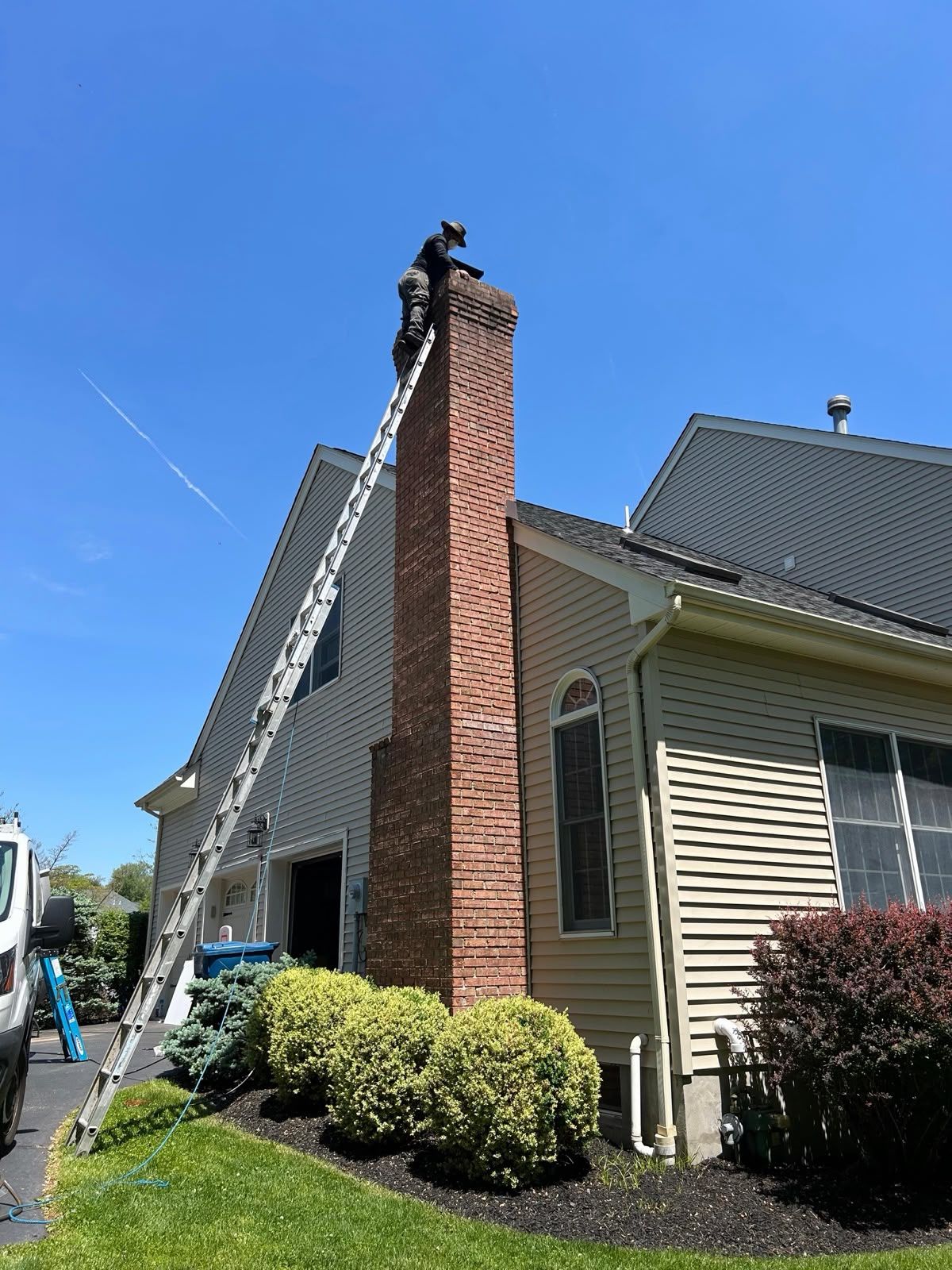
A bird or squirrel nest built over the summer is a full stop. A cap screen packed with soot and debris is nearly as effective. In the wooded counties, leaves and seed accumulate on caps every autumn. If a chimney drew fine last winter and does not now, and nothing else has changed, this is where to look first.
This one a sweep does fix, and it is found from the roof rather than from inside.
3. Creosote has narrowed the flue
Deposits build on the flue wall every time you burn. In a heavily used chimney the layer can become thick enough to measurably reduce the cross-section, and a smaller flue draws less.
Creosote also hardens over time, from brushable soot, to a flaky tar-hardened layer, to a glazed coating fused to the wall. The glazed stage is the one associated with chimney fires and it is very difficult to remove mechanically. Annual sweeping is what keeps the deposit in the stage a brush can handle.
Smouldering fires and unseasoned wood produce it fastest, because both put unburned volatiles up a relatively cool flue.
4. The damper is not fully open
Obvious, and it still happens, particularly with older cast dampers that have corroded. A damper that opens most of the way is a restriction at the narrowest point in the system. If yours takes force to move or does not travel fully, that is a repair rather than a sweep.
5. The house is competing with the chimney
Modern houses are tight, and mechanical systems move a lot of air. A kitchen extract fan, a bathroom fan, a clothes dryer or a whole-house fan running at the same time as a fire can pull the house negative enough to reverse a marginal flue.
Test it: open a window near the fireplace by an inch and see whether the smoking stops. If it does, you have a make-up air problem, not a chimney problem.
6. The smoke chamber or the opening is wrong
The smoke chamber above the firebox is supposed to funnel smoothly into the flue. Badly parged chambers, with stepped corbelling left rough, create turbulence exactly where the flow needs to be smooth.
There is also a relationship between the size of the fireplace opening and the flue area. An opening too large for its flue will smoke no matter what you do, and the usual fix is to reduce the opening height with a smoke guard.
Both of these are mason territory. We can tell you which one you are looking at and photograph it; we will not pretend a brush will change it.
7. Wind and terrain
Some chimneys smoke only in certain wind directions, usually because a nearby roof, tree or hillside creates downdraught over the flue top. A wind-directional cap can help. This is a diagnosis of exclusion: rule out the six above first.
What to do next
Start with the cheap checks: is the damper fully open, does opening a window fix it, and is the wood actually seasoned?
If none of those explain it, the next step is to look at the top of the flue, which means the roof. That is part of a standard sweep, and the photographs are what turn a guess into a diagnosis. If what we find is structural, you will be told to call a mason rather than sold something we cannot deliver.
And do the boring thing first: test the smoke and carbon monoxide alarms.


