How to Spot Mold in Your Westfield Home’s Air Ducts
What exactly are you smelling when your AC kicks on and the air turns stale and earthy? That question has a specific answer for many Westfield homeowners, and it is not a pleasant one. The short version: mold growing inside your ductwork is one of the most common culprits, and Union County’s humid summers give it exactly the conditions it needs to take hold. If you have noticed that smell, or spotted something dark and fuzzy near a vent cover, this guide walks you through what you are actually looking at and what comes next.
Why Westfield Homes Are Particularly Vulnerable
Westfield’s housing stock skews older. A significant portion of the borough’s residential neighborhoods were built between the 1920s and the 1970s, and many of those homes have ductwork that has never been professionally cleaned. Galvanized steel ducts from that era develop surface rust and pitting over time, giving mold spores a textured surface to colonize. Add in New Jersey’s muggy July and August humidity, a basement or crawl space that retains moisture, and an air conditioning system that cycles warm humid air before the coil has fully cooled, and you have a reliable recipe for fungal growth inside the channels that carry air to every room.
Homes that underwent additions or partial renovations are also at higher risk. When new ductwork is spliced into older runs without proper sealing, condensation can form at the joints. That standing moisture is where mold colonies typically start. If your home has a crawl space, the connection between ground-level moisture and your duct system is even more direct. For more on that specific pathway, see how crawl space moisture reaches your vents.
The Smell Comes First, Usually
Most Westfield homeowners notice the odor before they see anything. The smell is earthy, damp, sometimes described as similar to a wet basement or old library books. It tends to be strongest in the first few minutes after the system starts, then fades as the air circulates. That pattern matters: it tells you the source is inside the duct system itself, not somewhere else in the house. Mold sitting on duct surfaces gets disturbed the moment airflow begins, releasing spores and the musty compounds that produce the odor.
The smell alone is not proof of mold. Accumulated dust, dead insects, and general debris can produce similar odors. But a persistent musty smell that returns every cooling season, or that gets worse after a humid stretch of weather, points strongly toward a biological source rather than simple dust buildup.
If you want it handled correctly the first time, consider professional air duct cleaning in Westfield.
Visual Signs You Can Check Yourself
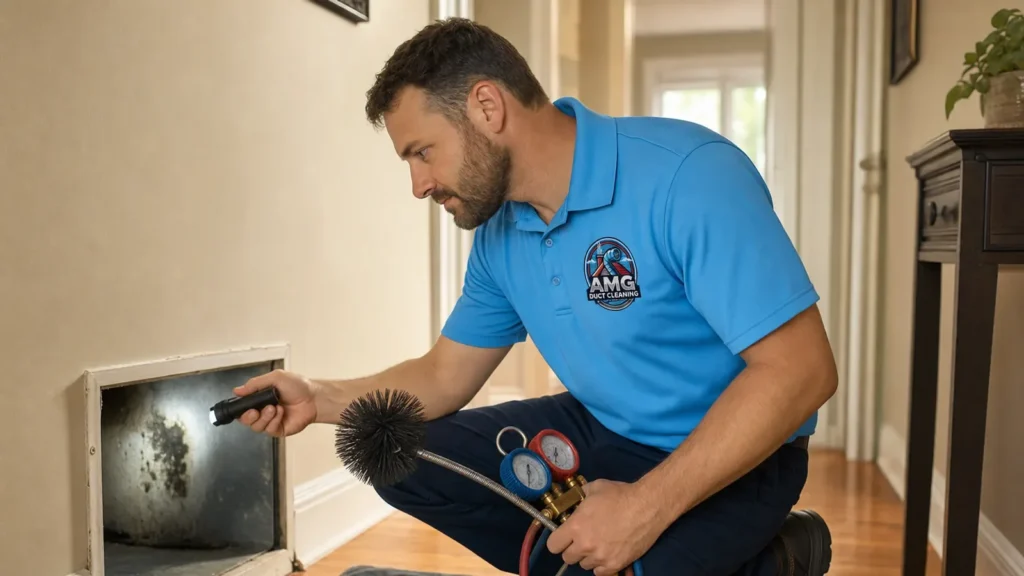
You do not need specialized equipment to do a first-pass inspection. Start at your supply and return vents. Remove the vent cover and look at the interior walls of the duct with a flashlight. Mold typically appears as dark gray, black, or greenish patches with a slightly fuzzy or powdery texture. It is distinct from ordinary dust, which tends to be uniformly gray and fluffy.
Pay particular attention to the area immediately around the evaporator coil if you can access it. This coil sits inside the air handler and is where refrigerant cools the air. It also collects condensation continuously during operation, which drains away through a condensate line. If that line is partially clogged, moisture backs up and creates a wet environment right at the start of your duct system. Mold growth near the coil can spread spores throughout every room the system serves.
Check the vent covers themselves. A dark, sooty ring around the perimeter of a supply vent, sometimes called ghosting, can indicate that particles including mold spores are being deposited as air passes through. It is not a definitive diagnosis, but it is a flag worth taking seriously.
What a Professional Inspection Reveals
A visual self-check has real limits. Ductwork runs through wall cavities, above ceilings, and under floors, and most of it is simply not accessible without equipment. A professional inspection uses cameras to look deep into the runs, and can identify colonies that would never show up on a homeowner’s flashlight survey. Technicians also check the condition of duct insulation, which, when it degrades, can trap moisture and become a mold substrate on its own.
Many Westfield homeowners rely on expert air duct cleaning in Westfield for exactly this.
If mold is confirmed, the remediation process goes beyond a simple cleaning. The affected sections need to be treated so that surface colonies are fully removed, not just disturbed and redistributed. This is a meaningful distinction: improper cleaning can actually worsen air quality temporarily by releasing a concentrated burst of spores. Proper HVAC system cleaning in Westfield addresses the full duct network, not just the accessible registers.
For homeowners wondering how frequently this kind of inspection should happen, ductwork cleaning intervals for NJ homes covers the factors that determine the right schedule for your specific system and house age.
What Happens After the Ducts Are Cleaned
The most immediate change homeowners notice is the startup smell. When the system has been properly cleaned and any mold colonies addressed, that first burst of air at the beginning of a cooling cycle no longer carries the earthy, stale quality. Air quality testing, if done before and after, typically shows a reduction in airborne particulates and mold spore counts.
Longer term, the system runs more efficiently. Mold and debris on duct surfaces create resistance that makes your HVAC work harder to push conditioned air through. Cleaner ducts mean better airflow to every room, which matters in a two-story Westfield colonial where the upstairs bedrooms are often the last to cool down on a hot August afternoon.
Keeping moisture under control after cleaning is the key to preventing recurrence. That means maintaining the condensate drain, keeping relative humidity in the house below 60 percent, and addressing any crawl space or basement moisture issues at their source. For guidance on maintaining what a cleaning achieves, post-cleaning duct maintenance is a useful next read.
Ready for the next step? Learn how air duct cleaning services in Westfield can help and reach out to the team.
Frequently Asked Questions
Can I clean mold from my air ducts myself?
Accessible vent covers can be wiped down, but mold inside the duct runs requires professional equipment to address safely. Disturbing a mold colony without proper containment and extraction can spread spores to other areas of the house, making the problem worse rather than better.
Is the musty smell from my vents always mold?
Not always. Accumulated dust, insect debris, and stagnant air can all produce a similar odor, especially at the start of a new cooling season. However, a smell that returns after rain or humid weather, or that intensifies over time, is more consistent with biological growth than ordinary debris.
How quickly does mold grow in ductwork?
Under the right conditions, mold can establish a visible colony within 24 to 48 hours of moisture exposure. In a New Jersey summer, where humidity is consistently high and air conditioning systems cycle frequently, ductwork that develops even a small moisture intrusion can show significant growth within a single season.
Does mold in ducts affect the whole house?
Yes. Because the duct system distributes air to every room, a colony in one section of the ductwork sends spores throughout the entire living space every time the system runs. This is why addressing the source matters more than treating individual vents or rooms.
If you have noticed the warning signs described here, the next step is a professional inspection. AMG Duct Cleaning serves Westfield and the surrounding Union County area. Reach out to schedule an assessment and get a clear picture of what is actually inside your ductwork.
