How to Meet Dryer Vent Fire Safety Standards in Westfield, NJ
A dryer vent that nobody checks is a slow-building hazard. Lint accumulates in the line after every load, and over months or years that buildup restricts airflow, raises exhaust temperatures, and creates the exact conditions that lead to laundry-room fires. In Westfield, NJ, where a large share of the housing stock dates to the mid-twentieth century, many homes were built before modern venting standards existed. Older ductwork, interior laundry closets, and long vent runs through finished walls are common here, and each factor makes lint removal harder and fire risk higher. This guide walks you through the concrete steps Westfield homeowners can take to bring their dryer vent system up to current safety standards and keep it there.
Before You Start: What You’ll Need
- A flathead and Phillips screwdriver
- A flashlight or phone torch
- A dryer vent brush kit (flexible rods with a lint brush head)
- A vacuum with a hose attachment
- Foil duct tape (not standard cloth duct tape)
- A tape measure
- Replacement rigid or semi-rigid metal duct sections if yours are plastic or foil accordion-style
- A notepad to record vent length, number of elbows, and any damage found
Before touching anything, unplug the dryer from the wall outlet (or switch off the gas supply valve if it is a gas model). Never work on a live appliance. If at any point you find a crushed section, a disconnected joint inside a wall, or signs of heat damage, stop and call a licensed professional rather than continuing.
Step 1: Locate Every Section of Your Dryer Vent Line
Start at the exhaust port on the back of the dryer and trace the vent path to the exterior termination cap. In many Westfield homes built in the 1950s through 1980s, that path runs through a laundry closet, across a basement ceiling, or up through a finished wall before exiting through the rim joist or an exterior wall. Sketch a rough map as you go, noting every elbow, every transition fitting, and the approximate total length. Current standards call for the shortest, straightest run possible, and each 90-degree elbow is roughly equivalent to several feet of straight duct in terms of airflow resistance. Knowing your layout tells you how demanding the cleaning job will be and whether any section of the line is inaccessible without opening a wall.
Step 2: Inspect the Duct Material Throughout the Run
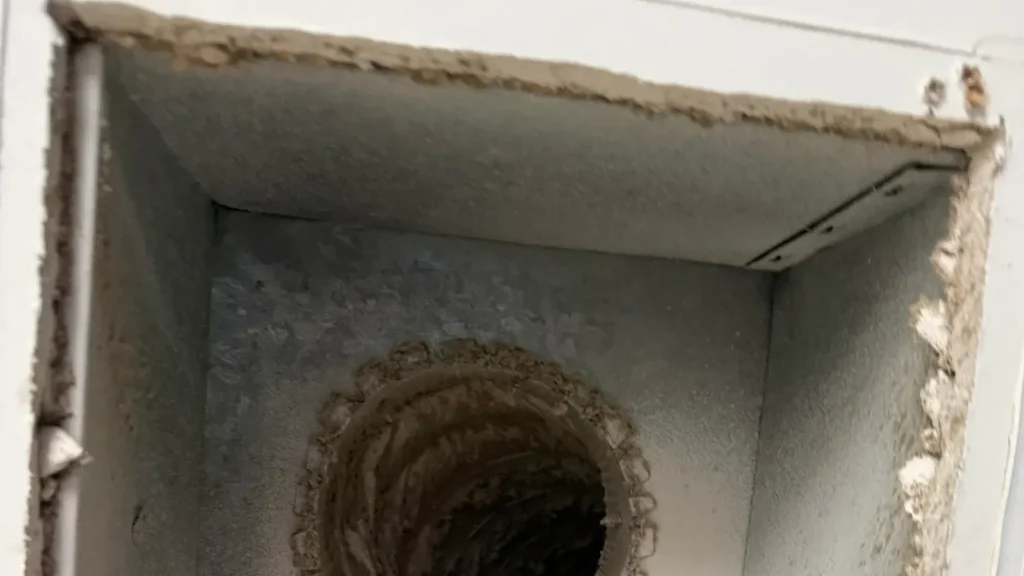
Pull the dryer away from the wall and examine the transition duct, the flexible connector that bridges the dryer exhaust port to the rigid duct in the wall. Plastic or thin foil accordion connectors are considered a fire hazard under current standards because they can sag, trap lint, and collapse. Replace any plastic or foil accordion transition with a UL-listed semi-rigid or rigid metal connector. The same applies to any section of the run you can access: rigid galvanized steel or rigid aluminum is the material of choice. Joints should be secured with foil duct tape, not sheet-metal screws that protrude into the duct and snag lint. Note any sections you cannot visually inspect, because those are the areas most likely to harbor hidden blockages. For a deeper look at what a severely blocked line looks like and how to diagnose it, see signs of a blocked dryer vent line.
Step 3: Check the Exterior Termination Cap
Go outside and find where the vent exits the house. In Westfield’s older colonials and Tudors, the cap is often low on the foundation wall or tucked behind shrubs, which means it can become blocked by vegetation, bird nests, or debris without anyone noticing. The cap should open freely when the dryer runs and close when it stops. A stuck or missing flap allows outside air, pests, and moisture back into the line. Remove the cap if it unscrews, clear any visible debris from the opening, and confirm the flap mechanism moves without resistance. Replace any cap that has a mesh screen behind the flap; screens trap lint and are not permitted under current standards. The cap opening should be at least 12 inches above grade and away from any window or door that could allow exhaust gases to re-enter the home.
If you want it handled correctly the first time, consider professional dryer vent cleaning in Westfield.
Step 4: Measure Total Duct Length and Elbow Count
Use your tape measure and the sketch from Step 1 to calculate the equivalent length of your vent run. Most dryer manufacturers specify a maximum equivalent length, typically in the range of 25 to 35 feet for a standard residential unit, but always check your specific appliance manual because the number varies. Subtract roughly five feet of equivalent length for each 90-degree elbow and roughly two to three feet for each 45-degree elbow. If your calculated equivalent length exceeds the manufacturer’s limit, the vent system is undersized for the run and will restrict airflow no matter how clean it is. In that situation, re-routing the duct or installing a booster fan (where permitted by local code) may be necessary. Requirements vary by municipality, so check with your local building department or consult a licensed contractor before making structural changes.
Step 5: Clean the Vent Line from Both Ends
With the dryer unplugged and the transition duct disconnected, feed the flexible brush kit into the duct from the laundry room end. Work the brush back and forth in short strokes, adding extension rods as you go deeper into the line. Lint will fall back toward you, so have the vacuum ready at the opening. Once you have worked through the full accessible length from the interior, go outside, remove the termination cap, and repeat the process from the exterior end. Brushing from both directions dislodges lint that has compacted at bends. After brushing, run the vacuum hose as far into each end as it will reach to capture loose debris. Reconnect the transition duct, restore power, and run the dryer on air-only (no heat) for a few minutes while you stand outside to confirm airflow at the cap is strong and steady. Weak airflow after cleaning suggests a blockage you could not reach, which points to a section inside a wall that needs professional attention.
Step 6: Verify Clearances and Code Compliance
Westfield falls under New Jersey’s Uniform Construction Code, which adopts the International Mechanical Code (IMC) for dryer exhaust systems. While the specific requirements can change and always need to be verified with your local building department, the IMC generally requires rigid or semi-rigid metal duct, a maximum equivalent duct length per the appliance listing, a backdraft damper at the termination, and no connection to any other duct system such as a bathroom exhaust or HVAC return. Gas dryers have additional requirements around combustion air and clearances that a licensed plumber or HVAC contractor should confirm. If your home was built before these standards were adopted, it may be grandfathered for existing conditions, but any new work or appliance replacement typically triggers compliance with current code. When in doubt, a quick call to the Westfield Building Department on Broad Street can clarify what applies to your specific situation.
Step 7: Document What You Found and Set a Maintenance Schedule
Write down the duct material, total length, number of elbows, termination cap condition, and the date of the cleaning. Keep this with your appliance manuals. A documented record is useful if you ever sell the home, file an insurance claim, or need to describe the system to a service technician. As a general guideline, most households benefit from a professional vent cleaning at least once a year. Households that do multiple loads daily, dry heavy items like pet bedding or work clothes, or have longer-than-average vent runs may need service more frequently. After a professional cleaning, the routine upkeep steps that extend a clean vent’s lifespan are straightforward and take only a few minutes per month.
Step 8: Know the Warning Signs That Require Immediate Action
Many Westfield homeowners rely on expert dryer vent cleaning in Westfield for exactly this.
Even between scheduled cleanings, certain signs mean the vent needs attention before the next laundry day. Clothes that take more than one cycle to dry fully, a dryer exterior that feels unusually hot to the touch, a burning or musty smell during operation, and a laundry room that feels more humid than the rest of the house are all indicators that airflow is compromised. A lint trap that fills faster than usual can also signal that lint is backing up into the drum rather than exhausting properly. If any of these appear, stop using the dryer until the vent is inspected. Using a dryer with a severely restricted vent is one of the more preventable causes of residential fires, and Westfield’s denser neighborhoods mean that a fire in one home can put neighboring properties at risk as well.
Step 9: Schedule a Professional Inspection After DIY Work
Homeowner cleaning handles the accessible portions of the vent, but sections inside walls, above ceilings, or in crawl spaces are difficult to reach and inspect without specialized equipment. A professional technician uses rotary brush systems and high-powered vacuums that can clear compacted lint from long runs, and a camera inspection can confirm that every section of the line is clear and intact. For a complete picture of what professional service covers versus what a homeowner can reasonably handle, comparing DIY and professional lint removal lays out the tradeoffs clearly. Scheduling a professional visit after your own cleaning is especially worthwhile if your home has a vent run longer than 15 feet, more than two elbows, or any section that passes through an inaccessible space. AMG Duct Cleaning offers free estimates for Westfield homeowners, so getting a professional assessment carries no upfront commitment.
Westfield NJ Housing Stock: Why Local Conditions Matter
Westfield’s residential neighborhoods are dominated by homes built between the 1920s and 1970s. Many of these properties were originally designed without dedicated laundry rooms; washers and dryers were added later, often in basement corners, interior closets, or converted spaces where running a short, straight vent to the exterior was not possible. The result is a higher-than-average share of homes with long vent runs, multiple elbows, and transitions through finished walls where damage or disconnection goes undetected for years. Westfield’s mature tree canopy also means exterior termination caps are more likely to accumulate debris from leaves and nesting birds, particularly in spring. These are not hypothetical concerns; they are the actual conditions that a technician encounters regularly when servicing homes in this part of Union County. Understanding your home’s specific layout is the first step toward keeping the vent system safe.
When to Call a Professional in Westfield
Call a licensed professional rather than continuing DIY work in any of these situations:
- The vent run passes through a finished wall or ceiling with no access panel.
- You find a disconnected joint, crushed section, or signs of heat damage (scorch marks, melted plastic, discolored metal).
- The dryer is a gas model and you notice any smell of gas near the appliance or vent.
- Airflow at the exterior cap remains weak after thorough brushing from both ends.
- The vent terminates in a crawl space, attic, or garage rather than directly to the outside (this is a code violation that requires re-routing).
- Your home is older than 40 years and the vent has never been professionally inspected.
Ready for the next step? Learn how dryer vent cleaning services in Westfield can help and reach out to the team.
For homeowners who want the entire dryer vent system assessed by a professional, dryer vent cleaning in Westfield NJ covers what a full-service appointment includes and how to prepare your home for it.
Frequently Asked Questions
How often should a dryer vent be cleaned in a typical Westfield home?
Once a year is a reasonable baseline for a household doing average laundry volume. Homes with longer vent runs, high laundry frequency, or pets that shed heavily may benefit from cleaning every six months. After a professional cleaning, keeping the lint trap clear after every load and checking the exterior cap seasonally helps extend the interval.
Is it required to use rigid metal duct for a dryer vent in New Jersey?
New Jersey’s Uniform Construction Code generally follows the International Mechanical Code, which requires rigid or semi-rigid metal duct for dryer exhaust. Plastic and thin foil accordion duct are not considered acceptable materials for new installations or replacements. Requirements can vary based on when your home was built and whether work triggers a permit, so confirm specifics with your local building department.
Can a dryer vent terminate in a crawl space or attic?
No. Dryer exhaust must terminate directly to the outside of the building. Terminating in a crawl space, attic, or any enclosed space creates a fire hazard, promotes mold growth from moisture, and is a code violation. If your vent currently terminates in one of these locations, re-routing is necessary and a permit will likely be required.
What is the maximum length for a residential dryer vent run?
The maximum equivalent length depends on the specific dryer model, so check your appliance manual first. As a general reference, the IMC sets a default maximum of 35 feet for a smooth-wall rigid duct with no elbows, reduced by an equivalent length for each elbow. Many older Westfield homes exceed this limit due to the way laundry areas were retrofitted, which is a strong argument for a professional assessment.
Does homeowner’s insurance cover dryer vent fires?
Coverage depends on the specific policy and the circumstances of the fire. Some insurers ask about dryer vent maintenance history during claims review. Maintaining a documented cleaning record is a practical way to demonstrate that reasonable precautions were taken, regardless of what a specific policy requires.
Keep Your Westfield Home Safe Year-Round
Dryer vent fire safety is not a one-time project; it is an ongoing maintenance practice that pays off in reduced risk and a dryer that runs efficiently for its full service life. The steps above give Westfield homeowners a clear framework for inspecting, cleaning, and documenting their vent system. For the sections of the line you cannot safely reach, or for a full system assessment backed by professional equipment, AMG Duct Cleaning offers free estimates with no pressure. Reach out to schedule an inspection and get a clear picture of where your vent system stands.
