Recognizing the Signs of Mold in Westfield Air Ducts
Most homeowners assume mold only grows in bathrooms or basements, but your ductwork is one of the most overlooked places it takes hold. In Westfield, NJ, where older Colonial and Tudor-style homes often have duct systems that have never been inspected, the problem can circulate through every room before anyone notices. Here is a practical checklist to help you catch it early.
Sensory Warning Signs: What You Smell and Feel
- Notice a musty or earthy odor that intensifies the moment the HVAC fan kicks on, then fades when the system is off.
- Detect a stale, damp smell concentrated near specific registers rather than evenly distributed through the house.
- Feel unexplained eye irritation, throat scratchiness, or a persistent runny nose that improves when you leave the house for several hours.
- Observe that allergy or asthma symptoms worsen in certain rooms served by the same duct branch.
- Notice the musty smell returns within days of opening windows or running the fan, suggesting the source is inside the system rather than in the room itself.
Visual Clues at Vents and Registers
- Look for dark gray, green, or black discoloration around the edges of supply or return vent covers.
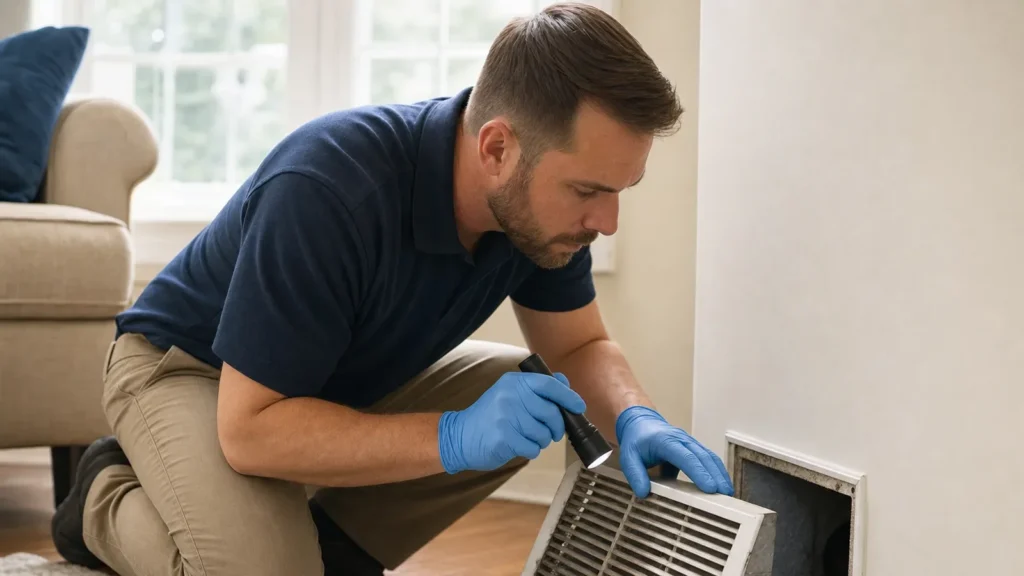
- Remove a vent cover and shine a flashlight into the first few inches of duct lining; look for fuzzy or powdery growth on the metal or insulation.
- Check for moisture streaks or rust staining on the outside of metal registers, which signal condensation inside the duct.
- Inspect flexible duct sections in the attic or basement for soft spots, sagging, or visible moisture on the outer jacket.
- Look for white or gray residue on vent grilles that cannot be wiped away with a dry cloth, which may indicate spore deposits rather than ordinary dust.
If you want it handled correctly the first time, consider professional air duct cleaning in Westfield.
HVAC System Behavior That Points to a Moisture Problem
- Note whether the system struggles to maintain set temperatures, since mold growth often accompanies insulation damage inside the duct lining that reduces efficiency.
- Listen for a wet or gurgling sound near the air handler, which may indicate a condensate drain backing up and introducing moisture into the supply plenum.
- Check the drip pan under the air handler; standing water or a visible slime line around the pan edge suggests chronic moisture that can migrate into connected ducts.
- Track whether changing the HVAC filter temporarily reduces the smell, then the odor returns within a week or two, pointing to a source deeper in the system.
- Observe whether the musty smell is stronger during humid summer months than in winter, which aligns with active mold growth cycles inside unconditioned duct runs.
Westfield-Specific Considerations
- Account for Westfield’s housing stock: many homes in the Mindowaskin Park and downtown neighborhoods were built between the 1920s and 1960s, and their original duct systems were sized for gravity or early forced-air furnaces, leaving irregular shapes that trap moisture and debris.
- Factor in Union County’s humid continental climate, where summer dew points regularly climb above 65°F, creating ideal condensation conditions inside supply ducts that pass through unconditioned attic or crawl space areas.
- Check basement duct runs carefully in homes near the Rahway River flood plain; even minor water intrusion events that did not damage living spaces can leave lasting moisture in below-grade ductwork.
- If your home has had a roof repair, bathroom renovation, or any interior water damage in the past few years, treat the connected duct zones as high-risk areas regardless of visible symptoms.
- Note that older Westfield homes with cast-iron plumbing and original plaster walls sometimes have hidden slow leaks behind walls that introduce moisture to nearby duct cavities without obvious surface staining.
Many Westfield homeowners rely on expert air duct cleaning in Westfield for exactly this.
When These Signs Require More Than a Filter Swap
- Understand that surface mold on a vent cover can be wiped away, but if the smell returns within a week, the colony is inside the duct lining where surface cleaning cannot reach.
- Recognize that mold spores released by a running HVAC fan travel to every room in the house, making a localized problem a whole-home air quality issue quickly.
- Accept that a professional inspection with a camera or probe is the only reliable way to confirm mold presence beyond the first few inches of a duct run.
- Schedule a professional duct inspection if two or more signs from the checklists above apply to your home, rather than waiting for symptoms to multiply.
- Ask your technician specifically about dryer vent condition during the same visit; lint-clogged dryer ducts create heat and moisture that can affect adjacent duct runs in shared utility chases.
- Review what to ask a duct cleaning company before booking so you know what a thorough mold remediation scope should include.
Frequently Asked Questions
Ready for the next step? Learn how air duct cleaning services in Westfield can help and reach out to the team.
Can mold grow in metal ducts, or only in insulated flex duct?
Mold can grow on any surface that holds moisture and organic material. Sheet metal ducts accumulate dust and debris over time, and that layer of organic matter is enough substrate for mold to colonize, especially where condensation forms on the cold metal surface during summer cooling cycles.
Is a musty smell from vents always mold?
Not always. Accumulated dust, dead insects, or a dirty evaporator coil can produce similar odors. However, a persistent musty smell that returns after filter changes and intensifies with humidity is a strong enough indicator to warrant a professional inspection rather than a wait-and-see approach.
How do I know if the mold is in the ducts versus somewhere else in the house?
The clearest indicator is timing: if the smell is strongest in the first few minutes after the HVAC fan starts and then dissipates as the air circulates, the source is most likely inside the duct system. Mold in walls or crawl spaces tends to produce a more constant, location-specific odor that does not track with fan cycles.
If several items on this checklist match what you are experiencing in your Westfield home, the next step is a direct look inside the system. Reach out to schedule your inspection, and see how to maintain your system after a cleaning to keep conditions from recurring.
