The Westfield Homeowner’s Guide to Indoor Air Quality Testing and Duct Care
Your home’s air can carry dust, mold spores, pet dander, and VOCs that you never see but breathe every day. For Westfield, NJ homeowners, the ductwork running through walls and ceilings is often the hidden source of those problems. This guide walks you through how indoor air quality testing actually works, what the results mean, and how professional duct care connects directly to the air your family breathes.
Why Westfield Homes Are Particularly Susceptible to Indoor Air Pollutants
Older Housing Stock and Duct Age
Westfield’s residential neighborhoods include a significant number of homes built between the 1950s and 1980s. Ductwork from that era was often installed with materials and sealing methods that degrade over decades. Gaps at joints, deteriorating flex duct liners, and accumulated debris inside supply and return plenums are common findings in homes of that age. Older duct systems don’t just lose efficiency; they become reservoirs for particulates that recirculate every time the HVAC fan runs.
Seasonal Pressure on HVAC Systems
New Jersey’s climate swings hard. Westfield homeowners run their heating systems through cold, dry winters and then flip to central air conditioning through humid summers. That cycle of heating and cooling creates condensation opportunities inside ductwork, which can encourage microbial growth if the ducts aren’t periodically cleaned. When you add in pollen season, the system pulls outdoor air contaminants through the filter and, if that filter is even slightly overwhelmed, into the duct walls themselves.
Tight Modern Insulation Makes It Worse
Many Westfield homeowners have upgraded insulation and windows in recent years, which is smart for energy bills. The trade-off is reduced natural ventilation. A tighter building envelope means indoor air recirculates more frequently without being diluted by fresh outdoor air. Whatever is in your ducts gets redistributed more often. That’s a strong argument for knowing what’s actually inside your duct system before assuming your air is fine.
What Indoor Air Quality Testing Actually Measures
Particulate Matter (PM2.5 and PM10)
Particulate matter testing measures the concentration of airborne particles by size. PM2.5 refers to particles 2.5 microns or smaller, fine enough to travel deep into the respiratory tract. PM10 covers coarser particles like dust and pollen fragments. A professional air quality test uses calibrated sensors or lab-analyzed samples to give you actual particle counts, not just a general impression. Elevated PM readings in multiple rooms, especially near supply vents, often point to the duct system as the distribution mechanism.
VOCs, Mold Spores, and Biological Contaminants
Volatile organic compounds (VOCs) off-gas from paints, adhesives, cleaning products, and furnishings. A comprehensive indoor air quality assessment can include VOC sampling alongside biological testing for mold spores and bacteria. Mold spore counts are especially relevant in ductwork because condensation zones inside ducts provide the moisture mold needs. If spore counts are elevated in a room served by a specific duct branch, that branch becomes the logical starting point for remediation.
Carbon Monoxide and Combustion Byproducts
Homes with gas furnaces, fireplaces, or attached garages need CO monitoring as part of any complete air quality picture. A cracked heat exchanger in a furnace can introduce combustion gases directly into the air stream. This is a safety issue, not just a comfort one. Requirements for CO detectors vary by local code, so check with your municipality or a licensed HVAC professional about what’s required for your home in Westfield specifically.
The Connection Between Dirty Ducts and Poor Air Quality Readings
How Contamination Builds Up Over Time
Every time your HVAC system runs, air passes through the return grilles, across the filter, through the air handler, and out through the supply ducts. Filters catch a lot, but not everything. Fine particles, biological material, and construction dust from renovations can bypass or accumulate on filter media and then deposit inside the duct walls. Over years, that buildup reaches a point where airflow disturbs it and sends it back into living spaces. Homeowners often notice this as a musty smell at system startup, or as dust settling on surfaces shortly after cleaning.
When Testing Points Directly at the Ducts
A useful diagnostic pattern: if air quality readings are significantly worse near supply vents than in the center of a room, the duct system is the likely source rather than furniture, flooring, or outdoor infiltration. Similarly, if particle counts spike when the HVAC fan turns on and then gradually decline when it’s off, that’s a strong indicator that the distribution system itself is contributing to the problem. Professional air quality testing can help establish this baseline before and after a duct cleaning so you can see the actual difference.
What a Visual Duct Inspection Reveals
Before any cleaning begins, a thorough inspection matters. At AMG Duct Cleaning in Westfield, the process starts with examining accessible duct sections, registers, and the air handler cabinet. Technicians look for visible debris accumulation, signs of moisture, damaged liner material, and gaps at joints. This inspection informs both the cleaning approach and whether any air duct repair work is needed to prevent recontamination after cleaning.
Duct Cleaning Is Not a One-Size-Fits-All Service
The NADCA Process Standard
The National Air Duct Cleaners Association (NADCA) sets the standard for how source removal duct cleaning should be performed. The process involves placing the system under negative pressure using a high-powered vacuum collection unit, then using agitation tools (brushes, air whips, or compressed air skippers) to dislodge debris from duct walls so it gets captured rather than redistributed. This is meaningfully different from a quick vacuum of visible register openings. When evaluating any duct cleaning service in NJ, asking whether the company follows the NADCA source removal process is a reasonable starting point.
Frequency: How Often Do Westfield Homes Actually Need It?
There’s no universal answer, but several factors push toward more frequent cleaning. Homes with pets that shed, recent renovation work (drywall dust is particularly problematic), occupants who are sensitive to airborne particles, or systems that haven’t been serviced in more than five years are reasonable candidates. For most Westfield homes without those factors, a cleaning every three to five years is a common professional recommendation. Air quality testing before and after gives you objective data rather than guesswork.
What Cleaning Won’t Fix
Duct cleaning removes accumulated debris, but it doesn’t seal leaky joints, repair collapsed flex duct sections, or correct undersized return air pathways. If your system has those issues, cleaning helps but doesn’t fully solve the air quality or efficiency problem. That’s why the inspection phase matters. A technician who finds damaged sections during a cleaning job should be able to explain what additional work is needed and why, so you can make an informed decision.
Comparing Your Options: DIY Checks vs. Professional Testing
| Approach | What It Tells You | Limitations | Best For |
|---|---|---|---|
| Consumer air quality monitor | Real-time PM2.5, VOC index, humidity, CO2 levels | No lab analysis, no mold spore detection, variable accuracy between brands | Ongoing awareness, spotting sudden changes |
| DIY mold test kit | Presence/absence of mold spores on a surface or in air | No species identification, no spore count, easy to misinterpret | Initial screening only |
| Professional air quality testing | Calibrated particle counts, VOC speciation, mold spore counts by species, CO and combustion gas levels | Point-in-time snapshot; conditions can vary by season | Pre/post duct cleaning verification, persistent symptoms, real estate transactions |
| Visual duct inspection | Debris accumulation, moisture signs, physical damage | Limited to accessible sections; doesn’t quantify airborne contamination | Deciding whether cleaning is warranted |
Signs Your Westfield Home Is Telling You to Test the Air
Dust That Comes Back Too Fast
Every home accumulates dust. But if surfaces near supply registers need wiping down within a day or two of cleaning, or if you notice a visible puff of debris when a vent first opens in the morning, the duct system is redistributing accumulated material. This is one of the most consistent signals homeowners describe before scheduling a cleaning. It’s not dramatic, but it’s reliable.
Odors That Follow the Airflow
Musty, stale, or burning smells that appear specifically when the HVAC system runs, and then dissipate when it shuts off, are worth taking seriously. A musty odor often suggests biological growth somewhere in the air stream, either in the duct walls, the drain pan, or the coil. A burning smell at the start of heating season can be normal dust burn-off, but if it persists past the first few cycles, it warrants investigation. Professional testing and inspection can help distinguish between a minor issue and one that needs prompt attention.
Uneven Temperatures Between Rooms
This one surprises people. Uneven heating or cooling isn’t just a comfort issue; it often indicates restricted airflow caused by debris buildup in specific duct branches, collapsed flex sections, or leaks that are losing conditioned air before it reaches the intended room. If one bedroom is always ten degrees warmer than the rest of the house, the duct serving that room deserves a look. AMG Duct Cleaning serves Westfield and the surrounding Union County area and regularly finds that airflow problems are the root cause of what homeowners assumed were thermostat or equipment issues.
What to Expect from a Professional Air Duct Cleaning in NJ
Before the Technician Arrives
Clear access to your air handler, furnace, and the registers in each room. Move furniture if a register is blocked. Make sure pets are secured in a separate space. The technician will need to access your electrical panel area if the air handler is in a utility space, and they’ll need a path to carry equipment through the home. A job on an average-sized Westfield home typically takes two to four hours depending on system size and duct configuration.
During the Cleaning
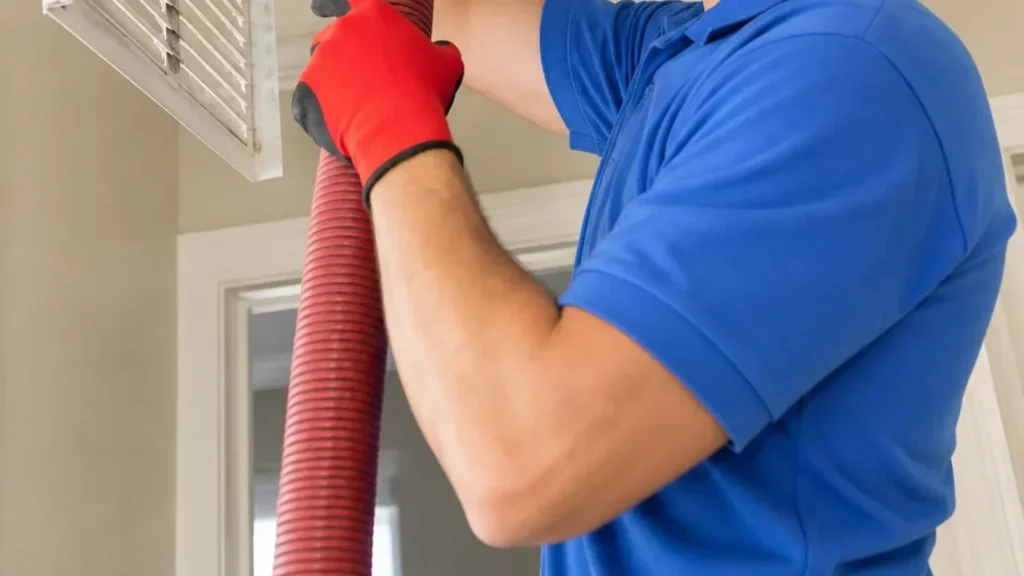
The technician connects a high-powered vacuum to the main trunk line or a large return duct, creating negative pressure throughout the system. Each supply and return branch is then cleaned with agitation tools while the vacuum captures the dislodged debris. Registers and grilles are removed, cleaned separately, and reinstalled. The air handler cabinet, blower compartment, and accessible coil surfaces are also cleaned as part of a complete HVAC system cleaning. You may hear the vacuum running continuously and some tapping or brushing sounds inside the walls. That’s normal.
After the Job
A good technician walks you through what they found: the condition of the ductwork, any areas of concern, and whether any follow-up work (repair, additional testing) is warranted. If you had air quality testing done before the cleaning, scheduling a follow-up test a week or two after the cleaning gives you a direct comparison. Homeowners often notice the air feels fresher at system startup and that dust accumulation on surfaces near vents slows down noticeably in the weeks following a thorough cleaning.
Frequently Asked Questions
How long does professional air quality testing take?
A thorough residential test typically takes one to three hours depending on the number of rooms sampled and the types of contaminants being measured. Lab analysis of collected samples can take several additional days before you receive a written report.
Can I run my HVAC system while the duct cleaning is happening?
No. The system needs to be off during cleaning so the technician can safely access duct sections and so the vacuum unit can maintain proper negative pressure. The technician will manage system shutoff and startup as part of the job.
Will duct cleaning make my home smell better immediately?
Many homeowners notice an improvement at the next system cycle after cleaning, particularly if musty odors were present before. However, if the odor source is a coil with biological growth or a drain pan issue, those components may need separate attention beyond duct cleaning alone.
Does duct cleaning help with dust from a recent renovation?
Yes, and renovation is one of the strongest reasons to schedule a cleaning. Drywall dust, insulation fibers, and sawdust are fine enough to pass through or around filters and coat the interior of duct walls. Running the system after a renovation without cleaning the ducts distributes that debris throughout the home repeatedly.
How do I know if I need duct repair in addition to cleaning?
Signs include visible gaps or disconnected sections at accessible joints, rooms that consistently receive weak airflow despite a clean filter, and higher-than-expected energy bills. The inspection before cleaning often surfaces these issues. A technician can document what they find so you can decide on next steps.
Does AMG Duct Cleaning offer free estimates?
Yes. AMG Duct Cleaning provides free estimates and free quotes for both residential and commercial customers in Westfield and the surrounding NJ area. You can reach out to discuss your specific situation before committing to any work.
Take the Next Step for Your Home’s Air
Clean ducts and accurate air quality data work together. Testing tells you what’s in your air; cleaning addresses one of the most common sources. If you’re a Westfield homeowner who hasn’t had either done in the past few years, now is a practical time to act. Schedule your air quality testing and duct inspection with AMG Duct Cleaning today and get a free estimate for your home.
