Keeping your kitchen exhaust hood filters clean is one of the most effective ways to reduce fire risk, maintain healthy airflow, and keep your kitchen compliant in Elizabeth, New Jersey. Whether you manage a bustling restaurant near Broad Street or run a community kitchen that prepares large volumes of food each week, regular attention to your filters preserves equipment, meets safety expectations, and protects your team and guests. If you are new to routine maintenance or want to refine your program, the following guide walks through everything you need to know about proper filter care, from preparation and removal to soaking, rinsing, drying, and reinstallation. It also explains how to document your work and when to call in professionals for more complex needs. For broader system maintenance, many teams in Union County rely on expert kitchen exhaust hood cleaning to handle areas beyond the filters, like ducts and fans, ensuring a complete solution.
Why clean hood filters regularly
Hood filters are your kitchen’s first defense against grease traveling into the ductwork. Every hour of cooking deposits a film of aerosolized grease onto baffle plates. If left in place, that residue restricts airflow, strains the fan motor, and increases the likelihood of flare-ups or duct fires. In a high-output environment—think fried chicken, burgers, or wok cooking—filters can load quickly. Clean filters help maintain capture velocity at the hood, control odors, and support comfortable kitchen temperatures. They also help you pass fire safety checks and health inspections in Elizabeth, New Jersey, where inspectors look for visible cleanliness, proper maintenance intervals, and documentation.
Know your filter type and size
Most commercial kitchens use stainless steel baffle filters because they are durable, resist corrosion, and meet fire code expectations. You may also encounter galvanized or aluminum filters in older installations, though these materials can be more susceptible to caustic degreasers. Before you begin, confirm the filter dimensions stamped on the frame and note the orientation arrows. Proper sizing ensures a snug fit with no bypass gaps, and correct orientation helps grease drain back to the collection trough instead of pooling in the hood.
Safety first: prepare the area
- Turn off cooking equipment and allow surfaces to cool to a safe handling temperature.
- Shut down the exhaust fan to prevent pulling degreaser mist into the duct.
- Lay absorbent pads or plastic sheeting over nearby appliances and floors to catch drips.
- Wear cut-resistant gloves, sleeves, and eye protection; baffle edges can be sharp and degreasers are caustic.
- If you will clean filters in a sink, ensure it is not used for food prep and that wastewater handling complies with local rules. Never discharge heavy grease into a floor drain without skimming solids first.
Tools and materials
- Food-safe, hood-rated degreaser compatible with stainless steel
- Large sink or soaking bin with hot water
- Non-abrasive brushes (nylon or soft fiber)
- Scrapers for heavy deposits (plastic or stainless)
- Spray bottles or pump sprayer
- Absorbent pads and rags
- pH test strips if neutralization is required by your chemical program
- Drying rack or clean, lint-free towels
Step-by-step: removing the filters
- Confirm the fan is off. Place a temporary sign to prevent others from switching it on.
- Support the bottom of the first baffle with one hand. Lift the filter to unseat the bottom edge from the retaining ledge.
- Angle the filter toward you and lower it carefully to avoid damaging the grease trough.
- Set each filter in a bus tub or on a cart lined with absorbent pads to transport to the cleaning area.
Pre-clean inspection
Before soaking, inspect each filter for dents, warping, broken welds, or clogged baffle channels. If you see pinholes, heavy corrosion, or frame separation, tag the filter for replacement. A damaged filter can leak grease, whistle loudly under airflow, or fall out of the hood during service. Keep a small stock of spare filters on hand so you can swap out any units that fail inspection without disrupting operations.
Degreasing and soaking
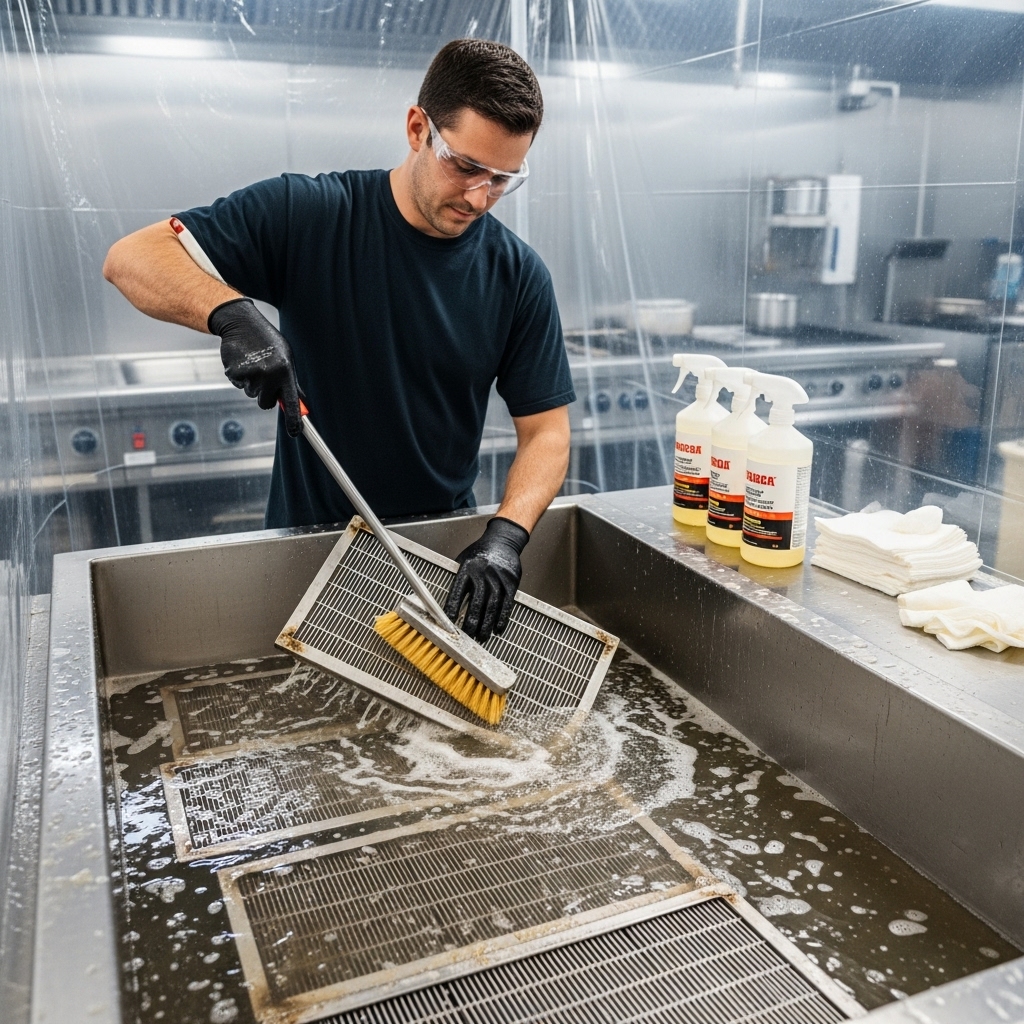
- Fill the sink or bin with hot water. Add degreaser according to label directions. Avoid over-concentrating, which can etch soft metals or create excessive foam.
- Fully submerge the filters. Agitate gently to release trapped air from the baffle channels so the solution reaches all surfaces.
- Soak time varies by soil load. Lightly soiled filters may need 10–15 minutes; heavy buildup can require 30–45 minutes with periodic agitation.
- While soaking, use a soft brush to work degreaser into corners and seams. Avoid wire brushes that scratch and create crevices where grease can lodge.
Rinsing and neutralizing
- Rinse with hot, clean water until runoff is clear and free of suds. Direct the spray at a 45-degree angle to flush the baffle openings.
- If your chemical program calls for a neutralizing rinse, verify pH using test strips and continue rinsing until the target range is reached. This protects stainless finishes and reduces the chance of chemical odor when the hood restarts.
Drying and reinstallation
- Place filters on a drying rack or stand them upright on absorbent pads. Airflow between baffles speeds drying and prevents water spots.
- Wipe frames with a lint-free towel. Ensure all corners are dry to prevent dripping into the hood.
- Reinstall with orientation arrows pointing up. Seat the top edge first, then swing the bottom edge into place on the retaining ledge. Verify firm engagement and no rattle.
- Once all filters are installed, restore power to the fan. Listen for unusual noise and verify strong capture at the hood face.
Pro tips for Elizabeth, New Jersey kitchens
- Adjust frequency to your menu. Fry-heavy operations in Elizabeth’s busy corridors typically clean filters daily or every other day; lighter-volume bistros may manage twice weekly.
- Rotate filter sets. Keeping a second set lets you swap immediately at closing and clean the used set the next morning.
- Use soak tanks for efficiency. A dedicated heated tank with metered chemistry maintains consistent results during peak seasons.
- Protect nearby equipment. New Jersey winters can encourage condensation in ducts. Clean, dry filters help reduce moisture capture and streaking on the hood face when cold air meets warm makeup air.
Troubleshooting common issues
If filters drip after installation, residual moisture is likely trapped in baffle channels. Remove, shake gently, and let stand a few more minutes before reinstalling. Whistling or humming sounds often indicate an air gap or a bent baffle; reseat or replace. Reduced capture at the hood may point to clogged mesh in the make-up air plenum or a roof fan belt issue; address these as part of your broader maintenance plan. If grease streaks appear on the front face of the hood, verify that arrows are oriented correctly and that the filters are the right size for the frame openings.
Cleaning frequency and documentation
Create a written schedule based on your production. Many Elizabeth establishments adopt a daily wipe-down and soak for heavy-use days, augmented by a weekly deep clean where filters soak longer and frames receive extra attention. Record the date, staff initials, observed condition, and any filter replacements in a simple log. This helps you demonstrate control during inspections and ensures consistency between shifts. Photographs taken after cleaning provide objective evidence and help you track wear over time.
Wastewater management and environmental care
When disposing of spent solution, skim grease solids first and follow your grease trap maintenance plan. Avoid dumping highly concentrated or hot degreaser into drains. If you outsource wastewater removal or use a mobile soak tank, verify that the vendor handles disposal responsibly and keeps manifests where required. Responsible handling prevents plumbing issues and supports community standards in Elizabeth.
When to call a professional
Even with diligent in-house filter care, the ductwork, plenum, and fan housing accumulate grease that requires specialized tools, hot-water pressure equipment, and trained technicians to clean safely. Mid-season, if you notice persistent odors, smoky conditions under normal load, or rapid filter loading even after proper cleaning, it may be a sign that the upstream system needs attention. In those cases, scheduling comprehensive kitchen exhaust hood cleaning can restore optimal airflow and reduce risk beyond what filter cleaning alone can achieve.
Training and staff engagement
Build a short training module for your team. Cover PPE, chemical safety, removal and installation, soak times, and inspection points. Many operators assign filter duty to closing staff, with the next shift verifying installation and capturing a quick photo for the log. Clear expectations lead to safer, faster, and more consistent results.
FAQs
Q: How often should I clean filters in a high-volume fryer kitchen? A: Daily cleaning is common for heavy frying. Some operators swap and soak at closing, with a deeper weekly clean to remove stubborn films.
Q: Can I put stainless steel baffle filters in the dishwasher? A: Many dishwashers lack the soak time and degreaser concentration to remove baked-on grease, and they can redeposit soils on other ware. A dedicated soak with the right chemistry is more effective.
Q: What if my filters are aluminum? A: Use an aluminum-safe degreaser and lower concentration. Test on a small area first to avoid etching.
Q: Why do my filters keep rattling? A: They may be slightly undersized, bent, or installed with the arrows down. Confirm the fit, straighten minor bends carefully, and reinstall correctly.
Q: Do inspectors in Elizabeth look at filter logs? A: Many do. Simple documentation demonstrates control and can streamline your inspection.
Keep your exhaust system resilient
Regular, methodical filter cleaning supports ventilation, safety, and comfort in your kitchen. It is the foundation of a system-wide plan that includes ducts, plenums, and fans. Make it routine, document it, and adjust based on your menu and seasons in Elizabeth.
Schedule service in Elizabeth, NJ today
If you are ready to elevate your program with a comprehensive partner, schedule professional kitchen exhaust hood cleaning to complement your in-house filter care. With trained technicians, proven methods, and a focus on safety and compliance, you can keep airflow strong, reduce fire risk, and give your staff the reliable ventilation they need to work comfortably and efficiently.
